Why are we like this?

So, the question humans have been asking for about 2,500 years, usually at 2am:
Why are we like this?
Two teams have spent centuries trying to answer it. The philosophers, who mostly think you can figure yourself out if you think hard enough. And the psychoanalysts, who think the part of you doing the thinking is the least reliable witness in the room.
They’ve been arguing ever since. And by the end of it, you still won’t know why you replied “hahaha.” But you’ll have some very interesting theories.
Before we start

Hi, I’m Luiza. I studied business, which was sensible, and then spent every spare moment reading Freud and Nietzsche, which was not. These days I teach teenagers, which means I spend a lot of time explaining difficult ideas to people who would rather be on their phones. If I can make Kierkegaard work at 9am on a Monday, I can make it work for you.
Every chapter starts with a question you’ve probably asked yourself. Why do I lie to myself? Why do I keep falling for the same type? Why does my family make me like this?
Then we bring in two guests. One psychoanalyst, usually Freud at the start, because he’s the gateway drug. And one philosopher who either got there first, argued back, or would have strongly disagreed over dinner. Sometimes they agree. Mostly they don’t.
We’ll look at where you’ve already seen these ideas in films, series and memes. Then there’s a “no-jokes box” at the end of every chapter, where I explain the actual idea in plain words, tell you who said it and which book it’s from. Because I want you laughing, but I also want you to leave knowing something real.
And every chapter ends with homework. Not the boring kind. The kind where you catch yourself doing the exact thing we just talked about.
Now, a few honest things before we start.
So get comfortable. Lie down if you want. It’s thematically appropriate.
Meet the two teams
Before the match starts, let’s meet the players.
Team Philosophy
The word comes from Greek: philo, love, and sophia, wisdom. So a philosopher is literally a “lover of wisdom,” which is the most flattering job title ever invented.
Philosophy has been around for about 2,500 years, and it asks the questions most people only ask after midnight. What’s real? How do I know anything? How should I live? What makes something right or wrong? Who am I?
Their main tool is thinking. Arguing, questioning, taking an idea apart to see if it holds up. Philosophers basically believe that if you reason carefully enough, you can get closer to the truth, including the truth about yourself.
Team Psychoanalysis
Much younger. Born in Vienna in the 1890s, and its founder is Sigmund Freud, a neurologist who got very interested in why his patients had symptoms that no medical test could explain.
Psychoanalysis is three things at once. It’s a theory of the mind, built on the idea that most of what drives us happens outside our awareness, in the unconscious. It’s a method of treatment, where you talk, and keep talking, and the important stuff slips out when you’re not paying attention. One of the first patients called it “the talking cure,” and the name stuck. And it’s a way of reading culture, because once you start looking for hidden meanings in dreams and jokes, you can’t stop doing it to films, books and your friends’ Instagram captions.
So what’s the difference?
One trusts the mind; the other is deeply suspicious of it.
Young Freud actually took philosophy classes at university in Vienna. So the founder of psychoanalysis was, briefly, on the other team. Which makes him, like me, someone who secretly wanted to study philosophy and ended up doing something else instead.
Socrates: Know thyself
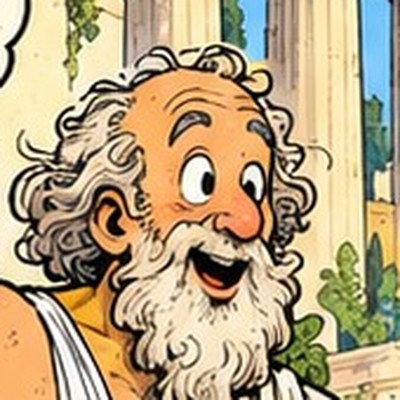
Meet Socrates. Athens, around 2,400 years ago. Famously ugly, by his own friends’ account. Walked around barefoot. Never wrote a single word down, so everything we know about him comes from his students, mainly Plato. Which means the most famous philosopher in history is basically known through his fan fiction.
His whole life started with a strange rumour. A friend of his went to the Oracle at Delphi, the ancient Greek version of asking the universe for a sign, and asked if anyone was wiser than Socrates. The answer: no one.
Socrates was confused. He was pretty sure he didn’t know much. So he went around Athens questioning everyone who seemed wise. Politicians, poets, craftsmen. And he kept finding the same thing: they thought they knew a lot, but when he asked follow-up questions, it all fell apart.
His conclusion: maybe he was the wisest because he was the only one who knew he didn’t know. You’ve probably seen this as “I know that I know nothing.” He never said it in those exact words. It’s a summary. Welcome to the course, where even the first quote is misquoted.
Now, above the entrance to that temple at Delphi were carved two words: know thyself. Socrates made it his life’s mission. His method was simple and deeply annoying: ask questions. Then ask questions about the answers. Then ask questions about those answers. Keep going until the other person realises they have no idea what they actually believe. Every teacher recognises this. It’s called “and why do you think that?”
He compared himself to a gadfly, a little insect that keeps biting a big lazy horse to keep it awake. The horse was Athens. Athens did not enjoy being bitten.
In the end, they put him on trial for disrespecting the gods and “corrupting the youth.” Basically, teaching teenagers to question everything. As a teacher of teenagers, I find this personally threatening. He was sentenced to death and made to drink poison. At his trial, he said the line he’s most famous for: the unexamined life is not worth living.
Socrates believed that nobody does wrong on purpose. If you really knew what was good for you, you’d do it. People only make bad choices because they don’t truly understand.
So, back to you at 2am. You know exactly what you should do, and you keep doing the opposite? Socrates would say: you don’t really know. If you did, you’d do it.
And a Viennese doctor, about 2,300 years later, would look at that and say: “Oh, sweet summer child.”
Freud: Good luck with that
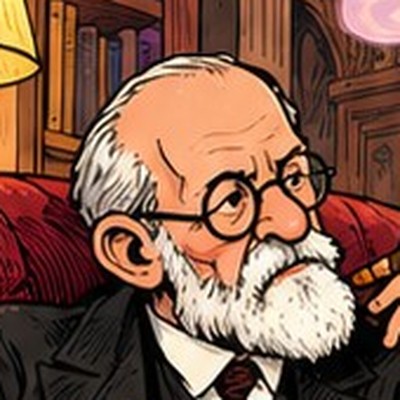
Fast forward about 2,300 years. Vienna, around 1900. Sigmund Freud has spent years listening to patients, and he’s noticed something Socrates would have hated.
People do know what’s good for them. They can explain it to you perfectly. They understand exactly why they should leave the bad relationship, stop the habit, call their mother back. And they still don’t do it.
So Freud’s answer to Socrates is: knowing isn’t the problem. The problem is that there’s a whole part of you that you don’t know. A part that has its own wishes, fears and plans, and doesn’t care at all what you’ve decided. He called it the unconscious.
You’ve probably seen the famous iceberg picture: a little bit of the mind above the water, and a huge hidden chunk below. It’s on every psychology poster in the world, and it’s always credited to Freud. Freud never actually used it. It came later, from other people explaining him. One chapter, two misquotes. We’re doing great.
Freud’s own favourite image was a rider on a horse. The rider is the part of you that thinks it’s in charge. The horse is much stronger. Most of the time, the rider can guide it. But very often, the rider ends up steering the horse where the horse was already going, and then telling everyone that was the plan all along.
That’s you at 2am watching octopus videos, saying “I’m just relaxing for five minutes.”
And Freud, being Freud, said this was a huge blow to humanity’s ego. He listed three of them. First, Copernicus told us the Earth isn’t the centre of the universe. Then Darwin told us we’re not separate from animals. And then, third, Freud told us we’re not even in charge of our own minds. He put himself next to Copernicus and Darwin. A very humble man.
So how do you “know thyself,” if most of you is hiding? You can’t just think harder, because the thinking part is the one that keeps making excuses. You have to catch the hidden part when it slips out: in dreams, in jokes, in the things you “accidentally” say, in the patterns you keep repeating. And usually, you need someone else to help you notice.
Which is funny, because that’s also what Socrates did. He asked people questions until the truth slipped out. Freud just did it with a couch and made people pay.
So, can you actually know yourself?
In one corner, a barefoot Athenian who never wrote anything down. In the other, a Viennese doctor who wrote everything down, including his own dreams. Let’s put them in a room.
Why do we do things we know are bad for us?
For Socrates, you’re confused. For Freud, you’re divided.
So how do you get to know yourself?
What would they say about each other?
Imaginary, of course. They missed each other by about 2,300 years.
So who wins?
No winner. But look at what they share. Both think self-knowledge is the most important thing a person can go after. Both think it’s much harder than it looks. And both think you get there through conversation, not by sitting alone and thinking really hard.
Where they split is on one question: can you trust your own mind? Socrates says yes, if you train it. Freud says: it’s charming that you think so.
That question follows us through the whole course.
You’ve seen this before
No-jokes box
Philosophy: From the Greek for “love of wisdom.” The use of reasoning and argument to investigate fundamental questions about reality, knowledge, ethics and the self. It dates back roughly 2,500 years in the Western tradition.
Psychoanalysis: Founded by Sigmund Freud in Vienna in the 1890s. It is a theory of the mind, a method of treatment (“the talking cure”) and a way of interpreting culture. Its central claim is that much of our mental life is unconscious and shapes our behaviour without our awareness.
Socrates (c. 469–399 BC): Athenian philosopher who wrote nothing; known mainly through Plato’s dialogues. He adopted the Delphic inscription “know thyself” and practised a method of relentless questioning to expose false beliefs. He was tried and executed in 399 BC for impiety and corrupting the youth.
Socrates’ key ideas: The unexamined life is not worth living (Plato’s Apology). No one does wrong willingly; wrongdoing comes from ignorance of what is truly good (Plato’s Protagoras, among others). Wisdom begins with recognising what you don’t know. “I know that I know nothing” is a popular paraphrase, not his exact words.
Freud’s key ideas: Much of the mind is unconscious. People can know what is good for them and still act against it because of inner conflict. The ego is “not master in its own house” (“A Difficulty in the Path of Psycho-Analysis,” 1917), and it relates to unconscious forces like a rider to a stronger horse (The Ego and the Id, 1923). The iceberg image is a later popularisation, not Freud’s own.
Where they meet: Both treat self-knowledge as essential and difficult, and both pursue it through dialogue.
Where they split: Socrates trusts trained reason to reach self-knowledge. Freud argues reason often produces justifications for unconscious motives, so self-knowledge needs indirect methods like free association and dream analysis.
- Plato’s Apology, Socrates’ defence at his trial. Short and very readable.
- Freud’s Introductory Lectures on Psycho-Analysis, written for a general audience.
- For overviews, Socrates: A Very Short Introduction by C.C.W. Taylor and Freud: A Very Short Introduction by Anthony Storr.
Homework