Am I a narcissist?
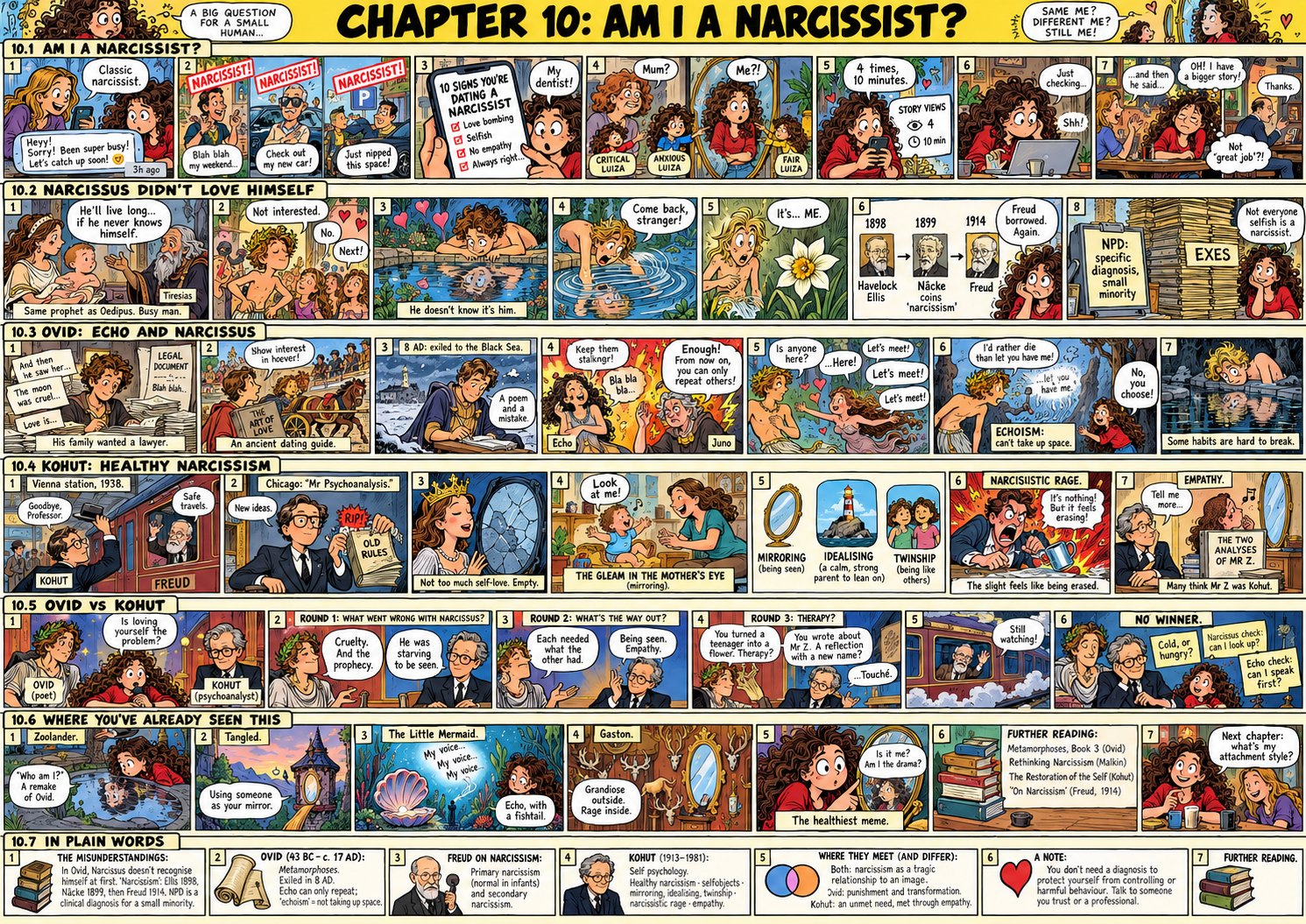
Your ex didn’t reply to your message for two days. Your friend reads it, puts down her phone, and says, with total confidence: “Classic narcissist.”
A colleague tells a long story about her weekend in a meeting. Narcissist. Your uncle talks about his new car for forty minutes. Narcissist. The man who took the last parking space? Probably also a narcissist.
You watch a TikTok called “Ten signs you’re dating a narcissist.” By sign seven, you’ve diagnosed every person you’ve ever met. Including your dentist. Including your mum. Including, slightly worryingly, yourself.
Because then you start noticing your own behaviour. You post a story and check who’s watched it. Four times. In ten minutes. Is that narcissistic?
You’ve googled your own name. More than once. Narcissistic?
At dinner, your friend is telling a story, and you’re not really listening. You’re waiting for her to finish so you can tell your story, which is about the same thing, but better. Narcissistic?
Your boss says “thanks” instead of “great job,” and you feel crushed for the whole afternoon. Is that narcissistic, or the opposite?
The word “narcissist” is everywhere now. It’s become the internet’s favourite way to explain anyone who’s hurt us. But if everyone’s a narcissist, then nobody really is. So what does it actually mean?
To find out, we’re going back to the original story, written by a Roman poet two thousand years ago. And spoiler: it’s not about a man who loved himself. And then we’ll meet a psychoanalyst from Vienna who said something that sounds outrageous at first: that a bit of narcissism is exactly what every one of us needs.
Narcissus didn’t love himself
You know the story, or you think you do. Narcissus was a beautiful young man who was so vain that he fell in love with his own reflection. Today, “narcissist” means someone obsessed with themselves.
Here’s what actually happens in the most famous version, written by the Roman poet Ovid.
When Narcissus is a baby, his mother asks a prophet whether her son will live a long life. And the prophet is Tiresias. Yes, the same blind prophet who tells Oedipus the truth in Level 1. Apparently he was the only prophet in Greek mythology with a booking system. His answer is strange and creepy: Narcissus will live a long life… if he never knows himself.
Remember “know thyself,” carved above the temple at Delphi? Socrates made it his life’s mission. For Narcissus, it’s a death sentence.
He grows up into a very beautiful sixteen-year-old who rejects everyone who falls in love with him. One day, hot and thirsty after hunting, he bends over a clear pool to drink, and he sees a beautiful face looking back at him. And he falls in love.
But he doesn’t know it’s him. He thinks it’s someone else. He reaches into the water to hold them, and they disappear. He tries to kiss them, and his lips touch water. He’s heartbroken that this beautiful stranger keeps slipping away.
It’s only after a long time that he finally realises: it’s me. That’s me in the water. And that realisation doesn’t make him happy and smug. It destroys him. He can’t leave the image, and he can’t have it. He wastes away by the pool, and turns into a flower: the narcissus.
So Narcissus isn’t really a man who loves himself. He’s a man who falls in love with an image he doesn’t recognise as his own, and is destroyed the moment he understands. If that sounds a lot like Oedipus, who doesn’t recognise his own mother, and like the jubilant baby in front of Lacan’s mirror in chapter 4, that’s because it is.
Crime number two. Everyone assumes Freud invented the psychological idea of “narcissism.” He didn’t. An English sexologist, Havelock Ellis, first compared a kind of self-love to the Narcissus myth in 1898, and a German psychiatrist, Paul Näcke, turned it into the word “narcissism” the year after. Freud picked it up a few years later and wrote a famous paper on it in 1914. Freud, quietly using someone else’s idea. Again. We’re no longer surprised.
Crime number three, the big one. Today, “narcissist” is one of the most used words on the internet. And there is a real condition, narcissistic personality disorder, which can cause genuine harm to the people around it. But it’s a specific clinical diagnosis, made by professionals, and it describes a fairly small proportion of people. Most of the people being called narcissists online are just selfish sometimes, or insecure, or careless, or going through something. Or they’re exes. Exes get called narcissists a lot.
Our next guest would add: a little bit of narcissism isn’t a disorder at all. It’s something every one of us needs to survive.
Ovid: Echo and Narcissus
Meet Ovid. Rome, around the time of Jesus. His family wanted him to become a lawyer, a respectable career. Ovid had other plans. He later wrote that whatever he tried to write somehow came out as poetry. So he became a poet, and one of the most popular in Rome.
His early hit was a book called The Art of Love. It’s basically a seduction guide, in verse. Where to meet people (the theatre, the chariot races), how to pretend you’re interested in their favourite horse, when to send a love letter. A two-thousand-year-old dating app, with footnotes.
Then something went badly wrong. In the year 8, the Emperor Augustus exiled him to a cold, remote town on the Black Sea, in what is now Romania. Ovid said it was because of “a poem and a mistake.” Nobody knows exactly what the mistake was. He spent the rest of his life writing very sad letters asking to come home. He never did.
But the same year he was exiled, he finished his masterpiece: the Metamorphoses, a gigantic poem full of hundreds of myths about transformation. People turning into trees, birds, stars, spiders. And one of its most famous stories is Narcissus. Except, in Ovid’s version, Narcissus isn’t the only main character.
Meet Echo.
Echo was a nymph who loved to talk. Too much. At one point, the goddess Juno was trying to catch her husband Jupiter cheating with other nymphs, and Echo kept her busy with endless chatter while the other nymphs escaped. When Juno realised, she cursed her: from now on, Echo could never speak first. She could only repeat the last few words other people said.
And then Echo fell in love with Narcissus.
She follows him through the woods, desperate to speak to him, but she can’t start a conversation. Then Narcissus, separated from his friends, calls out: “Is anyone here?” And Echo, overjoyed, answers: “Here!” He shouts: “Come!” She calls back: “Come!” He says: “Let’s meet here!” And she runs out of the trees, arms open, saying: “Let’s meet!”
And Narcissus pulls away in horror and shouts something like: “Get your hands off me! I’d rather die than let you have me!” And poor Echo can only repeat the last words: “…let you have me.”
Heartbroken, she hides in caves and slowly fades away, until there’s nothing left of her but her voice. That’s why, when you shout in a canyon, you still hear Echo answer.
So the original story has two people with two opposite problems. Narcissus can only see his own reflection, and doesn’t even know it’s him. Echo has no voice of her own at all, only other people’s words. One is so caught up in an image he can’t connect with anyone. The other is so lost in other people that there’s nothing left of herself.
Modern psychologists have even borrowed her name: “echoism” describes people who are so afraid of seeming selfish that they can’t take up any space, can’t ask for anything, and just reflect back what others want. The opposite problem to narcissism, and just as painful.
And Ovid’s final detail about Narcissus is very Ovid: even after he dies and goes down to the underworld, he’s still leaning over the black river there, staring at his own reflection in the water.
Some habits are hard to break.
Kohut: Healthy narcissism and the need to be seen
Meet Heinz Kohut. Born in Vienna in 1913, a doctor, and, like so many people in this course, forced to flee the Nazis. There’s a lovely story he liked to tell. In 1938, as a young man, he went to the Vienna train station on the day Freud left the city forever for London. As the train pulled out, Kohut raised his hat. And Freud, from the window, raised his hat back.
Kohut ended up in Chicago, and for years he was the most loyal Freudian imaginable. He became president of the American Psychoanalytic Association, and people jokingly called him “Mr Psychoanalysis.” He was the perfect son of the Freudian family.
And then, in his fifties, he started breaking the rules.
The problem was narcissism. Freud had seen it mostly as a problem: love that should be going out towards other people gets stuck on yourself instead. And Freud thought very narcissistic patients were almost impossible to help with psychoanalysis. They didn’t form the right kind of relationship with the analyst.
Kohut noticed something different in his own patients. They weren’t cold, arrogant people who loved themselves too much. Underneath, they seemed to feel empty, fragile and unreal, as if their sense of self could fall apart at any moment. They needed constant admiration not because they thought they were wonderful, but because without it, they felt like nothing.
So Kohut proposed something radical: narcissism isn’t just a disorder. It’s a normal part of being human, with a healthy version and an unhealthy one. And the healthy version is something every child needs.
Picture a toddler who’s just learned to jump off the bottom step. “Mummy! Look at me! Look!” And Mummy looks, and her face lights up: “Wow! Look at you!” Kohut called that look the gleam in the mother’s eye. And he said children need it, a lot. He called it mirroring: someone reflecting back to you that you exist, that you’re seen, that you’re delightful.
Remember Lacan’s baby in the mirror, turning around to the adult to ask “is that me?” Kohut would say: and the adult’s face matters even more than the mirror.
Children also need someone to look up to: a calm, strong parent they can lean on and admire, who makes them feel safe. Kohut called that idealising. And, later, he added a third need: to feel that you’re like other people, that you belong. He called it twinship.
When these needs are met well enough, with the normal little disappointments along the way (Winnicott would nod here), the child slowly builds a solid sense of self inside. The gleam in the mother’s eye becomes a gleam on the inside: healthy self-esteem, ambition, creativity, the ability to enjoy being yourself without needing constant applause.
But when those needs aren’t met, the self stays fragile. And the adult goes on looking for mirrors everywhere: likes, compliments, a boss saying “great job.” When they get it, they feel alive. When they don’t, they collapse, or they explode. Kohut called that explosion narcissistic rage: a massive overreaction to a tiny slight, because the slight doesn’t feel tiny. It feels like being erased.
So, back to the beginning of this chapter. Checking who’s watched your story four times? That’s the very human need for mirroring. Feeling crushed when your boss says “thanks” instead of “great job”? That’s the need to see the gleam in someone’s eye. It doesn’t make you a narcissist in the scary TikTok sense. It makes you a person. The question is how much you need the mirror, and what happens to you when it isn’t there.
And Kohut’s treatment? Not confronting people with how selfish they are. Empathy. He believed the analyst’s job was to understand, as closely as possible, what it feels like to be the patient, and to provide, slowly, some of the mirroring they missed.
One last on-brand detail. Kohut published a famous case history called “The Two Analyses of Mr Z,” about a young man treated twice: once the traditional Freudian way, and once Kohut’s new way. The second treatment worked much better. Many scholars now believe that Mr Z was Kohut himself.
A psychoanalyst who wrote about the need to be seen, and then wrote about himself under a fake name. If that isn’t the most human thing in this chapter, I don’t know what is.
Is loving yourself the problem?
Tonight: a poet exiled for “a poem and a mistake,” versus a psychoanalyst who raised his hat to Freud at a train station.
What actually went wrong with Narcissus?
So for Ovid, Narcissus is a warning about pride. For Kohut, he’s a case of hunger.
So what’s the way out?
What would they say to each other?
Imaginary, obviously. They’re about two thousand years apart.
And from the window of a departing train, Freud quietly raises his hat.
So who wins?
No winner, but a much more useful picture of narcissism than the one on your feed.
Everyone needs some narcissism. Everyone needs to be mirrored, to see the gleam in someone’s eye, to feel that they exist and matter. Checking who saw your story doesn’t make you a monster. It makes you a person who wants to be seen.
So next time you’re tempted to call someone a narcissist, try Kohut’s question first: are they cold, or are they hungry? It won’t excuse anyone who’s treating you badly. You’re still allowed to walk away from someone who hurts you. But it might help you understand what’s actually going on.
And for yourself, two quick checks from Ovid.
The Narcissus check: can I look up from the pool and actually see the people around me?
And the Echo check: can I say the first word, or do I only ever repeat what other people want?
Most of us need a bit of both: to stop staring at the water now and then, and to speak first now and then.
Where you’ve already seen this
In plain words
The misunderstandings: In the best-known ancient version of the myth, Ovid’s Metamorphoses (Book 3, c. 8 CE), Narcissus falls in love with his reflection without realising at first that it is himself; when he recognises it (iste ego sum, “I am he”), he wastes away and becomes the narcissus flower. The prophet Tiresias had foretold that he would live long “if he never knows himself.” The psychological concept of narcissism was not coined by Freud: Havelock Ellis linked a form of self-love to the myth in 1898, and Paul Näcke introduced the term Narcismus in 1899. Freud’s “On Narcissism: An Introduction” followed in 1914. In popular use, “narcissist” is often applied to anyone who has behaved selfishly or hurtfully; narcissistic personality disorder is a specific clinical diagnosis made by professionals and applies to a small minority of people.
Ovid (43 BCE – c. 17 CE): Roman poet, author of The Art of Love, the Metamorphoses and, after his exile by Augustus to Tomis on the Black Sea in 8 CE, the Tristia. In his version of the myth, the nymph Echo, cursed by Juno to repeat only the last words spoken by others, falls in love with Narcissus, is rejected, and fades until only her voice remains. Narcissus, punished for his indifference to those who loved him, falls in love with his own image. The modern term “echoism,” popularised by the psychologist Craig Malkin, describes people who avoid taking up space or expressing their own needs.
Freud on narcissism: In 1914, Freud described primary narcissism as a normal early state in which an infant’s libido is invested in itself, and secondary narcissism as libido withdrawn from others back onto the self. He regarded strongly narcissistic patients as difficult to treat by psychoanalysis.
Heinz Kohut (1913–1981): Austrian-American psychoanalyst, founder of self psychology (The Analysis of the Self, 1971; The Restoration of the Self, 1977). Key ideas:
- Narcissism has its own healthy line of development, leading to self-esteem, ambition and creativity, rather than being simply pathological.
- Children need selfobjects, others who meet core needs for the developing self: mirroring (being seen and admired, “the gleam in the mother’s eye”), idealising (a calm, strong figure to look up to), and twinship (a sense of being alike and belonging).
- When these needs are met well enough, with manageable disappointments, the child builds a cohesive self through what Kohut called transmuting internalisation.
- When they are not, the self remains fragile, leading to excessive dependence on others’ admiration and to narcissistic rage in response to perceived slights (“Thoughts on Narcissism and Narcissistic Rage,” 1972).
- The analyst’s central tool is empathy, understood as “vicarious introspection.” His case “The Two Analyses of Mr Z” (1979) is widely believed to be largely autobiographical.
Where they meet: Both Ovid’s myth and Kohut’s theory present narcissism not as simple vanity but as a tragic relationship to an image, connected to an inability to truly see others or be seen by them.
Where they differ: Ovid frames Narcissus’s fate as divine punishment and transformation, within a poem about change. Kohut frames narcissism as a developmental need that, when unmet, leaves a fragile self, and that can be addressed through empathic understanding.
A note: If someone’s behaviour towards you is consistently controlling, demeaning or harmful, you don’t need a diagnosis to protect yourself. Talking to someone you trust, or to a professional, can help, whatever label applies.
Further reading:
- Ovid’s Metamorphoses, Book 3, for Echo and Narcissus (and Tiresias). Older translations are public domain.
- Rethinking Narcissism by Craig Malkin, an accessible modern book on healthy narcissism, narcissistic traits and echoism.
- The Restoration of the Self (1977) by Heinz Kohut, for the more adventurous.
- Freud’s “On Narcissism: An Introduction” (1914), a short paper that started the psychoanalytic discussion.