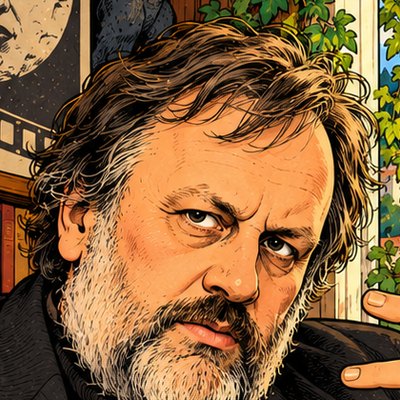
Why do we enjoy what makes us miserable?

So what’s going on? In Level 1, Freud told us we follow the pleasure principle: we chase what feels good. In chapter 7, he admitted that sometimes we don’t. But this is different. This isn’t just doing things that hurt. This is enjoying things that hurt. Getting something out of the misery.
An ancient Greek philosopher said the secret to happiness is simple pleasures, very few desires and absolutely no extra-hot curry. And a Slovenian philosopher, who can’t stop sniffing, touching his nose and explaining films, said the opposite: that the strangest, most powerful kind of enjoyment is exactly the one that hurts. And that, today, we’re all being ordered to enjoy ourselves. Which is why nobody can.
Epicurus would not have ordered dessert
Walk into any fancy food shop and you’ll see the word everywhere. “Epicurean delights.” “A paradise for epicures.” Expensive cheese, truffle oil, a tiny jar of jam that costs as much as a train ticket. Today, an “epicure” is someone who loves luxurious food and drink, and “epicurean” means indulgent, rich, a little bit decadent.
The man those words are named after lived mostly on bread and water.
Epicurus did believe pleasure was the goal of life. That part’s true. But his idea of pleasure was almost the opposite of what the word means today. He meant the absence of pain: no hunger, no fear, no anxiety. A calm body and a calm mind. He wrote, quite explicitly, that when he said pleasure was the goal, he did not mean endless parties, drinking and luxurious feasts. He meant not suffering.
The best detail comes from one of his own letters. He once wrote to a friend asking him to send a small pot of cheese, so that, in his words, he could have a feast whenever he liked.
A pot of cheese. That was the party. The man who gave his name to truffle oil considered cheese on bread a wild night out.
So how did he end up with the reputation of a glutton? Partly because of his enemies. Ancient critics hated his philosophy, and they spread rumours that he and his followers spent all day eating, drinking and partying. One former student, who’d fallen out with him, even claimed that Epicurus overate so much he made himself sick twice a day. Ancient gossip, basically. Two thousand years later, the gossip won. Food shops are still quoting it.
Crime number two. “Eat, drink and be merry, for tomorrow we die.” This line is constantly linked to Epicurus and his followers, as if it were their motto: enjoy everything now, because nothing matters.
It’s not from Epicurus. It’s from the Bible, a mix of two different passages, one about enjoying your food and drink, and another, more desperate one, about people feasting because they think they’re about to die. And Epicurus would have hated the second part. He spent a lot of effort trying to convince people not to fear death, so they could live calmly, not so they could panic-eat.
Crime number three, a small one. Our second guest’s favourite word is the French jouissance. It looks like it should just mean “enjoyment,” and it’s often translated that way. But in French it also has a legal meaning, the right to use and enjoy a property, and a much more intimate one, which I’ll let you look up yourself. Lacan, and then Žižek, used it for something stranger still: an enjoyment so intense it tips over into pain. Which is why translators usually just leave it in French and hope for the best.
So, on one side, a man who thought happiness was a small pot of cheese. On the other, a man who thinks we secretly enjoy our own suffering. Let’s meet them.
Epicurus: The Garden
Meet Epicurus. Born in 341 BC on the Greek island of Samos. The story goes that he got into philosophy at fourteen, when his school teacher read out an old poem saying that, in the beginning, there was Chaos. Little Epicurus put his hand up and asked: so where did Chaos come from? The teacher had no idea. So Epicurus decided to find out himself. Every teacher has met this child. Most of us just tell them to sit down.
Around 306 BC, he bought a house with a garden just outside Athens, and opened a school there. It became known simply as the Garden. Legend says a sign at the gate read something like: “Stranger, here you will do well to stay; here our highest good is pleasure.” Which, honestly, is a brilliant sign. Who wouldn’t walk in?
And the Garden was scandalous, for one main reason: it let in women. And enslaved people. In ancient Athens, philosophy was very much a men-only, rich-men-only club. Epicurus’s school had women studying, writing and discussing philosophy alongside everyone else. His enemies were horrified, and were happy to suggest that the place must therefore be one long party. It wasn’t. It was mostly friends, bread, water, vegetables from the garden and a lot of conversation. And, on special occasions, cheese.
He wrote around three hundred books. Almost all of them are lost. What survived is three letters, two lists of short sayings, and some burnt fragments. Some of those fragments came from an extraordinary place: a luxurious villa in Herculaneum, near Pompeii, which was buried by the eruption of Mount Vesuvius in 79 AD. Inside was a library of scrolls, carbonised by the volcano into lumps that look like burnt logs. Scientists are still trying to read them, now with X-rays and artificial intelligence. Many turn out to be Epicurean philosophy. So some of what we know about this calm, gentle philosopher was preserved by a volcano.
And one of his fans did something even stranger. Around 500 years after Epicurus died, a man called Diogenes in the town of Oenoanda, in what’s now Turkey, had Epicurus’s philosophy carved onto a giant stone wall in the middle of town, so everyone walking past could read it. The first philosophy billboard in history. The original “live, laugh, love,” except with footnotes.
So what did it say?
First, the goal of life is pleasure. But pleasure, for Epicurus, means two calm things: no pain in the body, and no worry in the mind. He had Greek words for them. Aponia: freedom from bodily pain. And ataraxia: peace of mind, tranquillity, an untroubled heart. Not excitement. Not fireworks. Calm.
Second, he sorted desires into three boxes, like a very sensible friend helping you clean out your wardrobe.
Natural and necessary: food, water, shelter, friends. Easy to satisfy, and you can’t live well without them.
Natural but unnecessary: fancy food, expensive wine, luxury. Fine sometimes. But don’t get attached to them, because they’re hard to get and easy to miss.
Empty desires: fame, power, huge wealth, endless status. These, he said, have no natural limit. However much you get, you’ll always want more. Remember the plush toy queue and the next phone in chapter 5? Epicurus would say those desires are a hamster wheel. Just step off.
Third, the most important ingredient in a happy life isn’t food, money or even philosophy. It’s friendship. He said that, of all the things wisdom gives us for living happily, the greatest by far is friends. He wasn’t joking. The whole school was built around living with them.
Fourth, stop being afraid. Later Epicureans summed up his teaching as a “four-part cure,” a kind of ancient prescription: don’t fear the gods; don’t worry about death; what’s good is easy to get; what’s terrible is easy to bear.
And on death, he had a famous argument: death is nothing to us. When we exist, death isn’t here. When death is here, we don’t exist. So we never actually meet it. Some of his followers even had a cheerful little epitaph carved on their gravestones, which translates roughly as: I was not, I was, I am not, I don’t care. The original “no regrets” tattoo.
But Epicurus wasn’t against all pain. He said sometimes you should choose a pain because it leads to a bigger pleasure later, like a sore body after a long hike, or going to the dentist. And sometimes you should refuse a pleasure because it brings bigger pain later, like the extra-hot curry, which you’ll be thinking about the next morning too. Pleasure, for him, wasn’t impulse. It was a calm, sensible calculation.
So what would he make of the start of this chapter? The 1am true crime podcast? Choosing fear right before sleep. Doomscrolling? Feeding your mind exactly what destroys its calm. The breakup playlist? Making the pain bigger on purpose. He’d be confused, and a little sad, and he’d probably offer you some cheese.
And here’s how he died. In his seventies, he suffered terribly from kidney stones. On his last day, in great pain, he wrote a letter to a friend saying it was the happiest day of his life, because the pain in his body was outweighed by the joy of remembering all their conversations together.
Which is the most Epicurean ending imaginable: even at the end, the cure was friendship.
Žižek: Jouissance, or why “enjoy!” is an order
Meet Slavoj Žižek. Born in 1949 in Ljubljana, in what was then Yugoslavia and is now Slovenia. If you’ve ever seen him speak, you’ll never forget it. He sniffs constantly. He touches his nose. He tugs at his T-shirt. He talks incredibly fast, in a strong accent, jumping from Hegel to Hitchcock to a dirty joke to Lacan and back again in under a minute, usually finishing his sentences with “and so on and so on.”
A journalist once called him “the Elvis of cultural theory.” A magazine called him “the most dangerous philosopher in the West.” He’s written dozens of books. In 1990, he ran in Slovenia’s first free elections for the country’s collective presidency, and narrowly missed out. In 2003, the clothing brand Abercrombie & Fitch printed bits of his writing in one of its catalogues, next to photos of half-naked models. He was delighted.
He also made two documentaries, The Pervert’s Guide to Cinema and The Pervert’s Guide to Ideology, where he analyses famous films while sitting inside recreated scenes from them: in the boat from Hitchcock’s The Birds, in the bed from Taxi Driver, eating out of a bin in They Live. Picture a philosophy lecture where the professor keeps wandering onto film sets. That’s Žižek.
Remember chapters 4 and 5? Žižek is Lacan’s most famous fan. He took Lacan’s impossible ideas and explained them through jokes, adverts, films and toilets. (Yes, toilets. He has a famous theory that German, French and American toilets reveal three different national philosophies. Look it up. You’ll never flush the same way again.)
And his favourite Lacan word is jouissance.
Remember Freud’s pleasure principle? Pleasure is pleasant. A warm bath. A nice biscuit. Jouissance is something else. It’s enjoyment that goes too far, so far that it starts to hurt, and yet you keep going. It’s the extra-hot curry that makes you cry while you say “this is amazing.” The true crime podcast at 1am that terrifies you, which is exactly why you press “next.” The scab you can’t stop picking. The breakup playlist you play on repeat. It’s not pleasure. It’s more intense than pleasure, and less comfortable.
And here’s Žižek’s twist. He says we even get jouissance out of the things we complain about. The lunch hour moaning about the boss? It’s the best hour of the day. You’re not just suffering your job. You’re enjoying suffering it, together. Hate-watching? You’re getting a very particular kind of enjoyment from being disgusted. Even your worst habits, your “symptoms” as Lacan called them, give you something. He wrote a whole book called Enjoy Your Symptom! Exclamation mark included.
That’s why it’s so hard to stop doing things that make you miserable. Part of you is getting something out of them.
Then comes his most famous idea, and the one that will probably change how you see your weekends.
In the old days, he says, society worked by saying “don’t.” Don’t have sex before marriage. Don’t eat too much. Don’t enjoy yourself, work hard, be modest. Freud’s patients suffered from too many “don’ts,” pushing their desires down.
Today, Žižek says, the message has flipped. Society’s new command is: “Enjoy!” Adverts, social media, your friends, the whole culture: enjoy your life, live your best life, treat yourself, you deserve it, make memories, YOLO. And that sounds like freedom. But it’s actually another order. Because now, if you’re not enjoying yourself enough, you feel guilty. Your holiday has to be amazing. Your Saturday has to be productive and relaxing and Instagrammable. Your thirtieth birthday has to be the best night of your life.
He has a perfect example. An old-fashioned father says to his child: “It’s Sunday, you’re going to visit your grandmother. I don’t care if you want to or not. You’re going.” The child can at least hate it in peace, and secretly enjoy rebelling against it. A modern, relaxed father says: “You know how much Grandma loves you. But only go if you really want to.” And Žižek says the second one is actually much worse. Because now the child has to go, and has to want to go, and has to enjoy it. You’re not just being told what to do. You’re being told what to feel about it.
And what about all those “guilt-free” products? Coffee without caffeine. Beer without alcohol. Cream without fat. Chocolate that’s good for you. Žižek loves these. He says they’re the perfect symbol of today: we want the enjoyment, but without the danger. The thing, but without the thing that makes it the thing. Even our morals come decaffeinated: when you buy a coffee from a chain that donates a few cents to charity, he says, you’re buying your coffee and your redemption from consumerism in the same paper cup.
And yes, he also has a theory about Kinder Surprise eggs. The chocolate is never really the point. The point is the little plastic surprise hidden inside, the mysterious “something more.” That’s Lacan’s objet petit a from chapter 5, in a chocolate egg. Every child who’s ever ignored the chocolate to get to the toy has understood Lacan better than most university students.
So, for Žižek, the question isn’t “how do I get more pleasure?” It’s: who told me I have to enjoy this? And what am I secretly enjoying about the things that make me miserable?
Which brings him into a very loud argument with a quiet man in a garden, holding a small pot of cheese.
Is happiness actually simple?
Tonight: a Greek philosopher in a quiet garden, eating bread and dreaming of cheese, versus a Slovenian philosopher sniffing, tugging his T-shirt and quoting Hitchcock.
What is real enjoyment?
So for Epicurus, real enjoyment is the absence of disturbance. For Žižek, real enjoyment is a disturbance.
So how do we live well?
Surprisingly, they agree on something. Both think the modern world sells us desires we don’t need. Epicurus would call them empty desires. Žižek would call them the superego shouting “Enjoy!” Same hamster wheel, different philosopher.
What would they say to each other?
Imaginary, of course. They’re about 2,300 years apart.
From the back of the Garden, Lacan, in a fur coat: Neither of you will ever be satisfied. That’s the whole point.
And from Vienna, Freud: I said the pleasure principle had problems in 1920. Nobody listens to me.
So who wins?
No winner, but a very useful pair of glasses for looking at your own life.
Epicurus’s lens: is this desire natural, or is it empty? Do I actually need this, or am I on the hamster wheel? Sometimes the most radical thing you can do is have a quiet evening with a friend, some bread and something nice to put on it.
Žižek’s lens: who told me I have to enjoy this? And, harder: what am I secretly enjoying about the thing that’s making me miserable? The lunchtime complaining, the doomscroll, the hate-watched show. Once you see what you’re getting from it, you can decide whether it’s worth it.
And here’s a little experiment combining both of them. Next weekend, give yourself permission not to have an amazing time. No pressure to be productive, relaxed, social or Instagrammable. Just ordinary. Žižek would call it rebellion. Epicurus would call it peace. You might just call it Sunday.
Where you’ve already seen this
In plain words
The misunderstandings: In modern English, “epicure” and “epicurean” suggest a love of luxurious food and drink. Epicurus taught that pleasure, the goal of life, consists mainly in the absence of bodily pain (aponia) and mental disturbance (ataraxia), and explicitly rejected drinking bouts and luxurious feasting as the meaning of pleasure (Letter to Menoeceus). He lived simply, and is reported to have asked a friend for “a little pot of cheese” so he could feast when he liked (Diogenes Laërtius 10.11). His reputation for indulgence owes much to hostile ancient critics. “Eat, drink and be merry, for tomorrow we die” combines two biblical passages (Ecclesiastes 8:15 and Isaiah 22:13) and is not Epicurus’s teaching. The French jouissance has legal and sexual meanings as well as “enjoyment”; in Lacan’s and Žižek’s usage it is usually left untranslated.
Epicurus (341–c. 270 BC): Greek philosopher who founded the school known as the Garden in Athens around 306 BC, notable for admitting women and enslaved people. Of his roughly 300 works, only three letters and two collections of sayings survive intact, alongside fragments, including Epicurean texts recovered from the carbonised library at Herculaneum and the public inscription of Diogenes of Oenoanda. Key ideas:
- Pleasure is the goal of life, understood as aponia and ataraxia.
- Desires are natural and necessary (food, shelter, friendship), natural but unnecessary (luxury), or empty (fame, power, great wealth), which have no natural limit and should be abandoned.
- Some pains should be chosen for greater pleasure later, and some pleasures avoided because they lead to greater pain.
- Friendship is the greatest good wisdom provides for a happy life (Principal Doctrines 27).
- Death is nothing to us: when we exist, death is not present, and when death is present, we do not exist.
- Later Epicureans summarised the teaching as the tetrapharmakos (“four-part cure”): don’t fear the gods, don’t worry about death, what is good is easy to get, what is terrible is easy to endure.
Slavoj Žižek (born 1949): Slovenian philosopher and cultural critic, known for interpreting Lacan, Hegel and Marx through popular culture, films and jokes. Key ideas:
- Jouissance: following Lacan, an excessive enjoyment “beyond the pleasure principle” that shades into pain, and that people often derive even from their suffering and symptoms (Enjoy Your Symptom!, 1992).
- The superego injunction to enjoy: where traditional authority prohibited enjoyment, contemporary culture commands it, producing guilt at not enjoying enough. His example contrasts an authoritarian father who orders a child to visit Grandma with a permissive one who says to go only if the child really wants to, which he argues is more oppressive (How to Read Lacan, 2006).
- “Decaffeinated” consumption: products and practices offering enjoyment stripped of its risky substance, such as decaf coffee, alcohol-free beer, and purchases bundled with charitable donations.
- Enjoyment also sustains ideology: people stay attached to systems partly because of the hidden satisfactions they provide.
Where they meet: Both are critical of the endless pursuit of desires that consumer culture encourages, and both suggest that what people chase is often not what would actually make them well.
Where they differ: Epicurus believes genuine pleasure is simple and calm, and achievable by limiting desire and cultivating friendship. Žižek holds that human enjoyment is inherently excessive and tangled up with suffering, and that the demand to be happy is itself a source of unhappiness; his focus is less on achieving calm than on exposing what we are really attached to and why.
Further reading:
- Epicurus’s Letter to Menoeceus. A few pages long, and the clearest summary of his ethics. Freely available in older translations.
- Travels with Epicurus by Daniel Klein, a gentle, funny book about applying Epicurus to everyday life.
- How to Read Lacan by Slavoj Žižek, short and full of examples.
- The Pervert’s Guide to Cinema (2006), the documentary, for Žižek at his most entertaining.
Goodbye to Level 2
So. Twelve chapters ago, you were complaining about a dramatic colleague for twenty minutes at dinner, while your friends exchanged a look.
Now you know that the colleague might have been carrying your shadow. That the person you love most is also allowed to drive you mad, and that’s not a disorder, it’s Melanie Klein. That “good enough” is the right amount, not the minimum. That the face in the mirror was invented by a jubilant baby, and that you want the giraffe mostly because someone else is holding it.
You know Napoleon was one metre sixty-nine. That Freud never wrote “Thanatos.” That one letter in a translation started a fifty-year argument. That being stoic doesn’t mean having no feelings, and that the Serenity Prayer isn’t two thousand years old. That Narcissus didn’t love himself, that your attachment style started as a quiz next to the weather forecast, and that the man whose name is written on every truffle oil jar thought a small pot of cheese was a wild night out.
Add those to Level 1, and that’s a lot of things you’ve been quoting wrong.
You’ve met a Swiss psychiatrist with a giant red book, a woman who analysed toddlers with a box of toys, a paediatrician on a bicycle, a Frenchman in a fur coat, a Viennese doctor who grew up in the shadow of two Sigmunds, a German psychoanalyst who walked out singing, a New Yorker who took a banana for a walk, a Stoic who was born enslaved, a poet exiled for “a poem and a mistake,” a man who raised his hat to Freud at a train station, a bearded philosopher who once met a horse, and a Slovenian who can’t stop sniffing.
And if there’s one thing almost all of them agree on, it’s this: you’re not one simple thing. You’re a mix of light and shadow, love and strife, the person you are and the person you think you should be. You learned to be “you” from other people, and you’ll keep becoming yourself through other people, for the rest of your life.
So no, you still don’t know exactly why you replied “hahaha.” But you’ve got a much better idea why you’re like this.
Be kind to the real you. Look up from the pool now and then. Say the first word. Send the voice note on the first take. And if you ever see a beige quote graphic that says “What you resist persists — Carl Jung”…
You’ll know exactly what to comment.