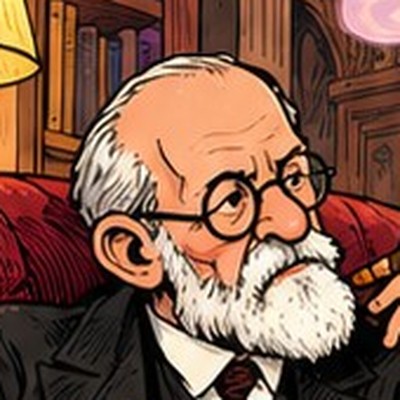
Was Freud right about any of this?

You read your horoscope. “You’ve been feeling pulled in two directions lately. Someone close to you needs more attention than they’re showing.” Wow. That’s exactly you. Then, just for fun, you read the one for a different star sign. It also fits perfectly.
Your friend explains everything with Mercury being in retrograde. Missed train? Mercury. Argument with her boyfriend? Mercury. Great day at work? “Mercury must be out of retrograde.” Whatever happens, the theory wins.
Your uncle has a theory about a secret group running the world. You show him evidence that it isn’t true. He smiles. “That’s exactly what they want you to think.” Now your evidence is proof that he’s right.
And now, the uncomfortable one. For eleven chapters, you’ve been hearing Freud’s ideas. So try this. Imagine you tell a psychoanalyst, “I don’t think I have any hidden anger towards my mother.” And they reply: “The fact that you’re denying it so strongly suggests you do.”
Hmm.
So what’s the difference between a theory that explains everything and a theory that explains nothing?
That’s this chapter. This is the breakup chapter. We’ve spent a whole course with Freud: we’ve laughed with him, argued with him, and seen how much of the modern world he shaped. Now it’s time to sit him down and have the honest conversation. What did he get right? What did he get badly wrong? And does it even matter anymore?
And we’ll do it with the help of a philosopher who grew up in Freud’s own city, looked at psychoanalysis, and asked the most dangerous question in science: how would you ever prove this wrong?
“Freud is dead”
In 1966, Time magazine published one of the most famous covers in history. Completely black, with three words in red: Is God Dead? Chapter 10 fans, you know exactly where that came from.
In 1993, Time did it again. This time the cover showed a picture of Freud, falling apart like a jigsaw puzzle, with the headline: Is Freud Dead?
And ever since, you’ll hear people say it with total confidence: “Freud’s been debunked.” “Nobody takes Freud seriously anymore.” “Science proved he was wrong.”
Notice something? Both covers were questions. Both had a question mark. And, just like with Nietzsche, people dropped the question mark and turned it into an announcement.
So is Freud dead? The honest answer is: parts of him, yes. Very dead. Other parts are alive and well, often working under different names. That’s what this chapter is about.
The second crime: the philosopher most often quoted as “proving Freud wrong” is Karl Popper. People say Popper showed psychoanalysis was false.
He didn’t. What Popper actually said was more interesting, and in some ways harsher. He said the problem with Freud’s theories wasn’t that they were wrong. It was that there was no way to show they were wrong. Whatever happened, the theory could explain it. And for Popper, a theory that can explain absolutely everything isn’t scientific at all.
But he also said something people almost never quote. He said Freud’s theories might still contain real insights. He compared them to myths: stories that can contain important truths, even if they aren’t science yet. And he thought some of those ideas might one day be turned into something testable.
So Popper didn’t say “Freud was wrong.” He said “Freud isn’t science.” Which isn’t the same thing. And it’s a much more useful thing to understand, because once you get the difference, you’ll never look at a horoscope, a conspiracy theory or a TikTok psychology video the same way again.
Popper: The test Freud couldn’t pass
Meet Karl Popper. Born in Vienna in 1902, so he grew up in the same city as psychoanalysis, at exactly the moment it was becoming famous. As a teenager, he was surrounded by exciting new theories that promised to explain everything: Marx’s theory of history, Freud’s psychoanalysis, and the ideas of Alfred Adler.
Quick side note on Adler. He was one of Freud’s early colleagues who split from him in 1911 and started his own school. And he’s the one who came up with the “inferiority complex.” Not Freud. Yes, another one for the list.
Young Popper actually worked with Adler for a while, in his clinics helping working-class children in Vienna. And one day he told Adler about a child whose case didn’t seem to fit Adler’s theory at all. Adler, who had never even met the child, explained it perfectly using his theory of inferiority feelings.
Popper was a bit shocked. He asked Adler how he could be so sure. Adler said: because of my thousandfold experience. And Popper, who was about seventeen, replied: and with this new case, I suppose, your experience is now thousand-and-one-fold.
Cheeky teenager. But he’d spotted something important.
Around the same time, in 1919, something big happened in physics. Einstein’s theory of relativity made a very specific, very risky prediction: that light from distant stars would bend by a certain amount as it passed the sun. If it didn’t bend, Einstein’s theory was wrong. Full stop. Scientists travelled to watch a solar eclipse, measured the starlight, and it bent, just as Einstein said.
Popper was hugely impressed. Not just because Einstein was right, but because Einstein could have been wrong. He’d stuck his neck out. He’d said: if you see this, my theory is dead.
Now compare that with Freud and Adler. Popper gave an example. Imagine two men. One pushes a child into the water, trying to drown it. The other jumps into the water, risking his life to save a child. Freud’s theory can explain both: the first man is acting on repressed aggression, the second has sublimated it. Adler’s theory can also explain both: both men are driven by feelings of inferiority, one proving he dares to commit a crime, the other proving he dares to be a hero.
Two opposite actions. Both explained perfectly. And that, said Popper, is exactly the problem. If your theory fits every possible situation, it’s not telling you anything about the world. It’s like the horoscope that fits every star sign.
This became Popper’s big idea: falsifiability. A scientific theory has to make claims that could, in principle, turn out to be false. It has to say “if you see this, I’m wrong.”
He used swans to explain it. You can see a thousand white swans, or a million, and you still haven’t proven that all swans are white. But one black swan, and the theory is finished. So science doesn’t progress by proving theories right. It progresses by trying hard to prove them wrong, and keeping the ones that survive.
Freud’s theory, Popper said, never offered a black swan. Nothing could ever count against it. Disagree, and that’s resistance. Deny it, and that’s denial. So, for Popper, psychoanalysis wasn’t false. It just wasn’t science.
Both men had to escape the Nazis. Popper left Austria in 1937 for New Zealand. Freud left in 1938 for London. And after the war, Popper ended up in London too, teaching at the London School of Economics. Two Viennese men who argued about the mind, in the same city, a few years apart.
The case against Freud
Let’s do this properly, like a courtroom. The defendant: Sigmund Freud. Here are the charges.
And when others tested that, it didn’t always work. In the 1920s, the anthropologist Bronisław Malinowski studied the Trobriand Islanders in the Pacific, where family life was organised around the mother’s side, and the uncle, not the father, was the main authority figure. The tension Freud expected between boys and their fathers? It seemed to be aimed at the uncle instead. So maybe the Oedipus complex isn’t universal. Maybe it’s a Viennese family drama.
And then there’s Dora. An eighteen-year-old girl, brought to Freud by her father. She told Freud that an older family friend had been making unwanted advances towards her since she was fourteen. Freud’s interpretation was that her disgust was hiding a secret desire for the man. She left after eleven weeks. Today, most people reading that case see a teenager who wasn’t believed.
And finally, when modern science tested specific claims, many didn’t hold up. Most dream researchers today, for example, don’t believe that every dream is a disguised wish.
So, the prosecution rests. It’s a strong case.
But before the verdict, the defence gets to speak.
The case for Freud
The defence would like to call its witnesses.
And remember the rider from chapter 1, who invents reasons for where the horse was already going? In a famous 1970s experiment, psychologists asked shoppers to choose the best pair from a row of identical stockings. People tended to pick the ones on the right. When asked why, they talked confidently about the quality, the fabric, the feel. Nobody said “because it was on the right.” They’d made up a perfectly reasonable explanation for a choice driven by something they weren’t aware of. Freud would have smiled.
So, the defence’s argument is this: Freud wasn’t right about everything. He wasn’t even right about most of the details. But he asked the right questions. And many of the people who proved him wrong were using tools and ideas he gave them.
If psychoanalysis isn’t science, does it still matter?
Tonight: two Viennese men who both ended up in London. One built the most famous theory of the mind in history. The other built the test it couldn’t pass.
What is psychoanalysis, really?
So is it worthless?
What would they say to each other?
Imaginary, as always, though they lived in the same city at the same time, so it almost could have happened.
So who wins?
For once, there’s something close to a real verdict.
Popper wins on the question of science. Psychoanalysis, as Freud built it, isn’t science in the strict sense, and many of its specific claims haven’t held up.
But Freud wins something too. He opened up a territory that nobody had properly explored: the hidden, irrational, contradictory parts of the human mind. His maps were wrong in places. Some were very wrong. But the territory was real, and a lot of people who came after him found their way around it using the paths he started.
So maybe the best way to read Freud is the way Popper suggested: not as a set of truths to believe, but as a collection of powerful ideas to test, argue with, and keep only when they survive.
And honestly? That’s the most important lesson of this whole course. Not just about Freud. About Nietzsche. About Plato. About every quote on Instagram and every psychology video on your feed. Before you believe something, ask Popper’s question: how would I know if this were wrong?
That one question will protect you from more nonsense than any philosopher ever could.
You’ve seen this before
No-jokes box
“Is Freud dead?”: Time magazine’s cover of 29 November 1993 asked this as a question, echoing its famous “Is God Dead?” cover of 8 April 1966. Both are often repeated as statements.
Karl Popper (1902–1994): Austrian-British philosopher of science, born in Vienna. In The Logic of Scientific Discovery (1934; English 1959), he argued that what distinguishes science from non-science is falsifiability: a scientific theory must make claims that could, in principle, be shown false by observation. No number of confirming instances can prove a universal theory (many white swans do not prove all swans are white), but a single counterexample can refute it. In Conjectures and Refutations (1963), he contrasted Einstein’s risky, testable predictions (confirmed by the 1919 eclipse observations) with the theories of Freud, Adler and Marx, which seemed able to explain any outcome. He did not claim psychoanalysis was false; he argued it was untestable, while suggesting it might contain valuable insights, as myths sometimes do before becoming testable science.
Main criticisms of Freud: Key claims are difficult or impossible to falsify; evidence came largely from his own interpretations; his patient base was small and culturally specific; the universality of the Oedipus complex was questioned by anthropologists such as Bronisław Malinowski; several famous cases (Anna O, the Wolf Man, Dora) were less successful than presented; his abandonment of the “seduction theory” in 1897 remains debated; his theories of female psychology were widely criticised, including by Karen Horney; his early promotion of cocaine had harmful consequences; and many specific claims, such as the wish-fulfilment theory of all dreams, have not been supported by later research.
Ideas with lasting influence: The existence of mental processes outside awareness is widely accepted in cognitive science, though not in Freud’s specific form; research such as Nisbett and Wilson’s (1977) shows people often give confident but inaccurate reasons for their choices. Defence mechanisms continue to be studied, for example in George Vaillant’s work on the Harvard Grant Study. Talk therapy as a practice grew from psychoanalysis; the founders of cognitive therapy and attachment theory, Aaron Beck and John Bowlby, both trained psychoanalytically. Modern psychodynamic therapy has research support, though its comparative effectiveness remains debated. The idea that early experience shapes adult life is now widely accepted.
Where they meet: Freud and Popper both came from Vienna, both fled the Nazis, both ended up in London, and both were concerned with what we can truly know.
Where they differ: Freud regarded psychoanalysis as a science of the mind. Popper held that it was not science because it could not be tested, though its ideas might still prove valuable.
Where to go next:
- Popper’s Conjectures and Refutations, chapter 1, “Science: Conjectures and Refutations.” Clear, lively and short, with the Adler story.
- Freud: A Very Short Introduction by Anthony Storr, which ends with a fair assessment of his legacy.
- Philosophy of Science: A Very Short Introduction by Samir Okasha, which explains falsifiability and its limits.
- Freud’s own An Autobiographical Study (1925), to hear him make his case in his own words.
Homework
Goodbye (for now)
So. Twelve chapters ago, you were lying in bed at 2am, watching videos about octopuses, asking: why are we like this?
I promised you wouldn’t get a final answer. I kept that promise. But look at what you’ve got instead.
You know that “God is dead” was a warning, not a caption. That the unconscious existed before Freud, and that Freud never said “id,” “ego,” “Freudian slip” or “sometimes a cigar is just a cigar.” That Oedipus never had an Oedipus complex, that your “other half” came from a comedian with hiccups, and that “anxiety is the dizziness of freedom” was technically written by the Watchman of Copenhagen.
You’ve met a barefoot Athenian, a grumpy man with poodles, a lens-grinder, a playwright, a café waiter, a butterfly, a charioteer, and a teenager who told Alfred Adler his experience was now thousand-and-one-fold.
And you’ve learned the most important skill of all: not what to think, but how to question what you’re told. Including what I told you.
Socrates said the unexamined life isn’t worth living. Freud said examining it is harder than it looks. Popper said: fine, but check your evidence.
In Level 2, we go deeper. Jung and his shadow. Melanie Klein and why we love and hate the same person. Winnicott and the good-enough mother. Lacan, who makes Freud look simple. The death drive. Camus, Beauvoir, and a Slovenian philosopher who can’t stop analysing films.
Until then, lie down. Rest. You’ve earned it.
And next time you see a black-and-white photo on Instagram with the caption “God is dead.” — Nietzsche…
You’ll know exactly what to comment.