Why do I hate in others what I hide in myself?
And sometimes, you meet someone, and before they’ve even finished saying hello, you just know you don’t like them. Something about them. You can’t explain it. You don’t need to. You just know.
An uncomfortable idea: what if the people who annoy you most aren’t telling you much about themselves at all? What if they’re telling you about you?
About a hundred years ago, a Swiss psychiatrist suggested that every one of us has a hidden side: all the parts of ourselves we’ve decided we’re not allowed to be. And that we don’t get rid of those parts. We just see them in other people, and hate them there instead.
He called it the shadow. And a German philosopher had already warned, decades earlier, about what happens when you spend too long fighting monsters.
Welcome back

Hi again. If you’re here, you survived Level 1. You know that “God is dead” was a warning, that Freud never said “Freudian slip,” and that your other half came from a comedian with hiccups. You’ve also learned to ask the most annoying question in the world: how would I know if this were wrong? Keep asking it. You’ll need it here.
Because Level 2 is different.
In Level 1, Freud was the main character. Every chapter, he walked in, sat down, lit a cigar and argued with a philosopher. This time, he mostly stays home. Level 2 belongs to the people who came after him: his students, his rivals, and the ones who took his ideas somewhere he’d never have gone, or would have hated.
You’ll meet the Swiss psychiatrist who was once Freud’s favourite, until he wasn’t. A woman who psychoanalysed toddlers and decided that babies are much angrier than anyone wanted to admit. A paediatrician who told exhausted parents that being imperfect is actually the point. A Frenchman so difficult to read that even his fans argue about what he meant. And a few women Freud badly underestimated, who answered him back.
The philosophers get tougher too. Hegel, Camus, Beauvoir, the Stoics, and a Slovenian who can’t watch a film without explaining what it says about capitalism.
Some of these ideas are hard. I promise I’ll make them survivable. I’ve explained harder things to fourteen-year-olds.
Same rules as before. Every chapter starts with a question you’ve actually asked yourself. Two guests, who mostly disagree. At least one thing you’ve been quoting wrong. Where you’ve already seen it on screen. And everything in plain words at the end, so you leave knowing something real.
Right. Let’s start with the part of you that you’d rather nobody saw.
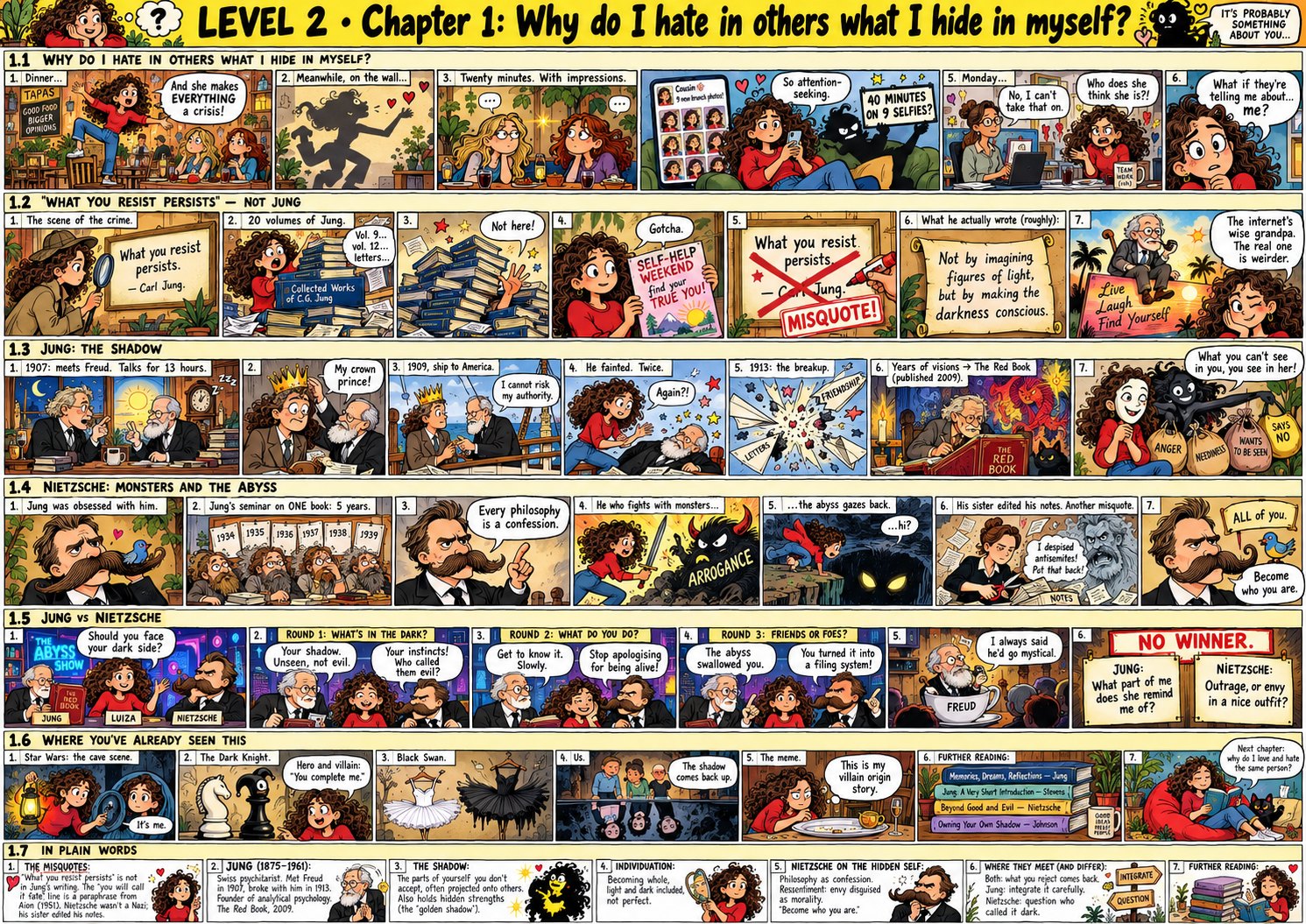
“What you resist persists”
You’ve seen it. Usually on a calm beige background, sometimes over a photo of a forest: “What you resist persists.” — Carl Jung.
It’s catchy. It even sounds like something Jung might say. But nobody has ever found it in his writing. His collected works run to around twenty volumes, plus letters, seminars and interviews. It isn’t there. The phrase seems to have come from the self-help world of the 1970s, and at some point someone stuck Jung’s name on it, because a quote sounds wiser with a famous Swiss face next to it.
Another one: “Until you make the unconscious conscious, it will direct your life and you will call it fate.” This one’s shared millions of times, and it’s closer to the truth. Jung did write something like it, but his actual version is shorter and stranger. Roughly: when an inner situation isn’t made conscious, it happens outside, as fate. No “direct your life.” No neat little self-help bow. Just a slightly creepy idea that what you refuse to see inside yourself will come and find you from the outside.
Jung has become the internet’s favourite wise grandfather. Freud gets the jokes about mothers and cigars; Jung gets the inspirational quotes over sunsets. And a lot of them are made up, or polished until they barely resemble what he wrote.
Which is a shame, because the real Jung is much more interesting. One he actually did write, and the heart of this chapter: you don’t become enlightened by imagining figures of light, but by making the darkness conscious.
In other words: stop picturing yourself as the nice, calm, good person in the beige quote graphic. Go and look at the parts you’re hiding. That’s where the work is.
So who was this man, and what was he hiding?
Jung: The shadow
Meet Carl Gustav Jung. Born in Switzerland in 1875, the son of a pastor. A tall, confident psychiatrist working at a famous hospital in Zurich, fascinated by the strange inner worlds of his patients.
In 1907, he travelled to Vienna to meet Freud. They talked for thirteen hours straight. That’s not a meeting, that’s a second date that turned into a weekend. Freud adored him. He called Jung his “crown prince,” his heir, the man who would carry psychoanalysis into the future. In 1910, Jung became the first president of the International Psychoanalytical Association.
And then, as in every great love story, things got complicated.
In 1909, they sailed to America together to give lectures, and to pass the time, they analysed each other’s dreams. At one point, according to Jung, Freud refused to share some personal details about his own dream, saying he couldn’t risk his authority. Jung said that was the moment Freud lost it. Freud also fainted in front of Jung, twice, in different years, both times during tense conversations. Freud, of course, had his own interpretation of that.
The real fight was about ideas. Freud believed that sexual energy was at the heart of the unconscious. Jung thought that was far too narrow: for him, the unconscious was bigger, older, full of myths, symbols, religion and meaning. By 1912, Jung was writing Freud sharp letters accusing him of treating his followers like patients. By 1913, they’d broken off contact. They never spoke again.
What followed for Jung was a dark few years. He went through what he called his “confrontation with the unconscious”: intense visions, dreams and fantasies that he recorded and painted in an enormous, beautiful, very strange book, which wasn’t published until 2009. It’s called The Red Book. Some see it as a breakdown. Others see it as a breakthrough. Jung saw it as the source of everything he wrote afterwards.
So what did he write?
Jung said the mind has a few layers. On the surface, there’s the persona. And behind the mask, there’s the shadow. Anger, if you were raised to be nice. Ambition, if you were taught that wanting things is selfish. Neediness, if you learned early that nobody would come. Vanity, laziness, jealousy, desire.
What you can’t see in yourself, you see in other people. That’s projection, which you met in Level 1, but Jung put it at the centre of everything. The colleague who’s “so dramatic”? Maybe she’s carrying the part of you that wants to be seen, and isn’t allowed to. The friend who’s “so needy”? Maybe she’s doing the asking you’ve never let yourself do.
A normal annoyance is “she talks a lot.” A shadow reaction is twenty minutes of impressions at dinner.
But the shadow isn’t only the bad stuff. It also holds good qualities you never let yourself develop. Confidence, if you were told not to show off. Assertiveness, if saying no wasn’t safe. The colleague who calmly says no to extra work? You’re not just irritated by her. Part of you envies her. Later Jungians called this the golden shadow.
So what do you do with your shadow? Jung’s answer wasn’t to get rid of it. You can’t. It was to get to know it, and slowly bring it back. Not to become perfect, but to become whole. He called this lifelong process individuation: becoming the full person you actually are, light and dark included.
And that’s exactly where a certain German philosopher, who Jung read obsessively, comes in with a warning.
Nietzsche: Monsters and the abyss
You met Nietzsche in Level 1, panicking about the death of God. Jung was obsessed with him. He read Thus Spoke Zarathustra as a young man and never really got over it. Decades later, he ran a seminar in Zurich devoted entirely to that one book. It lasted five years.
Nietzsche called himself a psychologist long before psychology was a proper job. And one of his favourite tricks was to look at something that seemed noble, like a moral rule, or a philosophy, or a person’s anger at someone else, and ask: what’s really going on underneath?
He even did it to philosophy itself. Every great philosophy, he wrote, is really a confession by its author, a kind of memoir they didn’t know they were writing. Which is a very Jungian thing to say: when you describe the world, you’re secretly describing yourself.
He also had a word for one particular hidden motive: ressentiment. He used the French word, because German didn’t have one sharp enough. It’s what happens when you feel weak or powerless next to someone, and instead of admitting envy, you turn it into a moral judgement. You can’t be confident like them, so you decide confidence is arrogant. You can’t say no like them, so you decide saying no is selfish. Who does she think she is? Nietzsche would smile at that one. It sounds like a moral complaint. It might be a wish in disguise.
But his most famous lines for this chapter come from a book called Beyond Good and Evil, from 1886. In an old public domain translation, it reads:
“He who fights with monsters should be careful lest he thereby become a monster. And if thou gaze long into an abyss, the abyss will also gaze into thee.”
Read it with the shadow in mind, and it says two things.
First, the monster part. If you spend your life fighting what you hate in others, you can become exactly that thing. The person who’s constantly furious about everyone else’s arrogance can turn into the most arrogant person in the room. The one who’s obsessed with exposing other people’s hypocrisy stops noticing their own. The more you hate your shadow in someone else, the more it takes you over.
Second, the abyss part. Looking into darkness isn’t safe. It changes you. If you stare at the dark side of humanity, or your own, it stares back. Which is exactly the risk Jung took during his Red Book years. Some people think he came close to falling in.
And Nietzsche himself? In January 1889, in the Italian city of Turin, he collapsed, and never recovered his mind. There’s a famous story that it happened after he threw his arms around a horse that was being whipped in the street. It’s probably partly legend. He spent his last eleven years being cared for by his mother and then his sister, and died in 1900.
His sister, by the way, is a whole other misquote story. She took control of his unpublished notes, edited them to fit her own politics, and later welcomed the Nazis, who made Nietzsche one of their favourite philosophers. Nietzsche himself had openly despised antisemites. So if you’ve ever heard that Nietzsche was a Nazi philosopher: that’s another thing you’ve been quoting wrong.
But back to the shadow. Nietzsche didn’t just warn about the abyss. He also gave one of his most hopeful instructions, which he borrowed from an ancient Greek poet: become who you are. Not who you’re supposed to be. Not the polished version. All of you.
Which sounds a lot like Jung’s individuation. So, did they agree? Mostly. But not entirely.
Should you face your dark side?
Tonight: a Swiss psychiatrist who painted his visions in a giant red book, versus a German philosopher with a legendary moustache who looked into the abyss and didn’t come back.
What’s actually in the dark?
So both say the dark isn’t simply bad. But Jung wants to understand it. Nietzsche wants to question who decided it was dark in the first place.
So what should you do about it?
What would they say to each other?
Imaginary, of course. Nietzsche collapsed in 1889, when Jung was fourteen.
And from somewhere in Vienna, Freud mutters: I always said he’d go mystical.
So who wins?
No winner, but a lot of agreement. Both say you can’t simply destroy your dark side. Both say what you deny in yourself comes back, often aimed at other people. And both say the goal isn’t to become perfect. It’s to become whole, or, in Nietzsche’s words, to become who you are.
So next time someone gets under your skin far more than they should, try two questions.
And keep his warning in mind, especially online. When you see a crowd tearing someone apart for being cruel, arrogant or hypocritical, and you feel the urge to join in with something even crueller, that’s the moment to remember: he who fights with monsters should be careful lest he thereby become a monster.
Where you’ve already seen this
In plain words
The misquotes: “What you resist persists” has no known source in Jung’s writings and appears to come from 1970s self-help programmes. “Until you make the unconscious conscious, it will direct your life and you will call it fate” is a popular paraphrase of a shorter passage in Aion (1951), which says that an inner situation not made conscious happens outside, as fate. Nietzsche was not a Nazi philosopher: he openly opposed antisemitism, and his sister, Elisabeth Förster-Nietzsche, edited his unpublished notes and later supported the Nazi regime.
Carl Gustav Jung (1875–1961): Swiss psychiatrist and founder of analytical psychology. He met Freud in 1907, became first president of the International Psychoanalytical Association in 1910, and broke with Freud in 1913, largely over Freud’s emphasis on sexuality. He then went through a period he called his “confrontation with the unconscious,” recorded in The Red Book (published 2009). His key concepts include the personal unconscious and the collective unconscious, archetypes, the persona (the social mask), the shadow, and individuation.
The shadow: The parts of the personality a person does not recognise or accept in themselves, which often become visible through projection onto others. The shadow can contain undesirable traits but also undeveloped positive qualities, sometimes called the “golden shadow” by later Jungians. Jung argued that the shadow cannot be eliminated, only made conscious and integrated: “One does not become enlightened by imagining figures of light, but by making the darkness conscious” (“The Philosophical Tree,” 1945).
Individuation: Jung’s term for the lifelong process of becoming a whole, integrated person, including the conscious and unconscious, the persona and the shadow.
Friedrich Nietzsche (1844–1900) on the hidden self: Nietzsche treated philosophy and morality as expressions of hidden psychological motives; every great philosophy, he wrote, is “the confession of its originator” (Beyond Good and Evil, 1886, section 6). In On the Genealogy of Morals (1887), he described ressentiment, in which feelings of powerlessness and envy are converted into moral judgements against others. Beyond Good and Evil, section 146, warns that “he who fights with monsters should be careful lest he thereby become a monster,” and that “if thou gaze long into an abyss, the abyss will also gaze into thee.” He urged readers to “become who you are” (The Gay Science, section 270) and to love their fate (amor fati).
Jung and Nietzsche: Jung read Nietzsche from youth and devoted a seminar to Thus Spoke Zarathustra from 1934 to 1939, where he argued that Nietzsche had become overwhelmed by unconscious forces he identified with.
Where they meet: Both hold that what we reject in ourselves does not disappear, that our judgements of others often reveal hidden parts of ourselves, and that the goal is wholeness rather than moral perfection.
Where they differ: Jung seeks to make unconscious material conscious and integrate it carefully, warning against being overwhelmed by it. Nietzsche questions the moral categories themselves, arguing that much of what is called “evil” is suppressed vitality, and calls for self-overcoming and the creation of new values.
- Jung’s Memories, Dreams, Reflections (1962), his memoir. The most readable way into his life and ideas.
- Jung: A Very Short Introduction by Anthony Stevens.
- Nietzsche’s Beyond Good and Evil, especially Part Four, “Apophthegms and Interludes,” which is short aphorisms you can read in any order. Public domain translations are freely available.
- Owning Your Own Shadow by Robert A. Johnson, a short, accessible Jungian book on the shadow.