Why do I love and hate the same person?
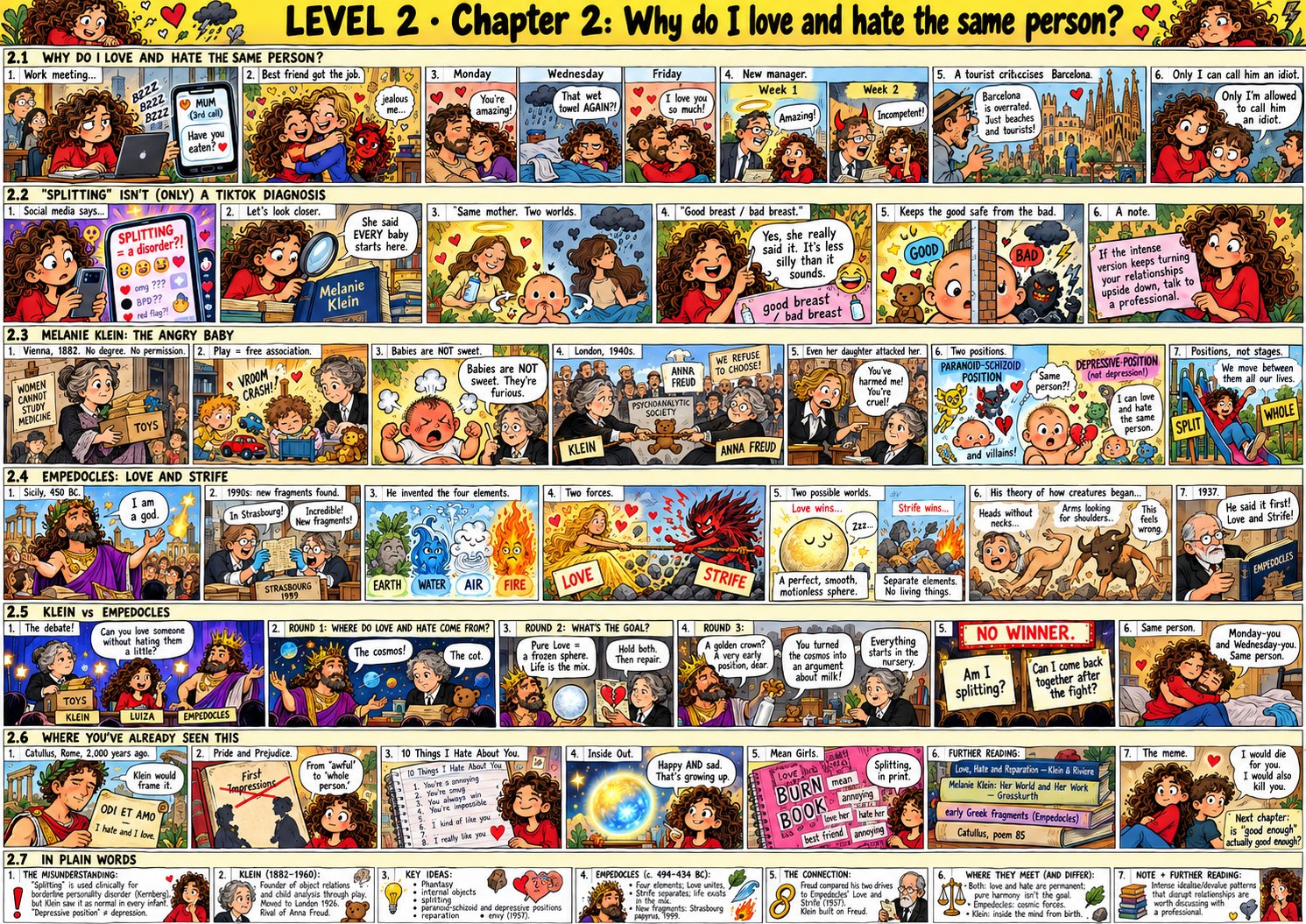
So why can’t our feelings just stay put? Why does the person we love most also manage to make us angriest? And why do we flip so fast, from “amazing” to “terrible,” with almost nothing in between?
Two very different thinkers had an answer. A woman in the 1920s who spent her time watching small children play, and came to a very uncomfortable conclusion about babies. And a Greek philosopher, 2,400 years earlier, who said the entire universe works exactly the same way.
“Splitting” isn’t (only) a TikTok diagnosis
If you’ve spent any time on mental health TikTok, you’ve seen the word splitting. Usually in videos about borderline personality disorder: someone describing how a person they adored yesterday suddenly feels like the worst person in the world today, with no in-between. And for people living with that condition, it’s a real, exhausting and often painful experience. Clinicians do use the term that way.
What most of those videos don’t mention: The idea didn’t start as a label for one condition. It started with a woman who believed that every single one of us begins life splitting the world in two.
Her name was Melanie Klein. And in her version, splitting isn’t a sign that something has gone wrong. It’s where everybody starts. The question isn’t whether you split. It’s how much, how often, and whether you learned, over time, to bring the two halves back together.
Which means the examples at the start of this chapter aren’t a list of symptoms. The new manager who goes from amazing to incompetent in a week, the partner who’s perfect on Monday and unbearable on Wednesday: that’s not a diagnosis. That’s a normal human mind, under a bit of stress, slipping back into a very old habit.
And while we’re here, the other thing people know about Klein: the phrase “good breast and bad breast.” It turns up in memes, usually with a lot of laughing emojis. And yes, she really did say it. But it’s not as ridiculous as it sounds. She meant that a tiny baby experiences the same source of food and comfort as two completely different things: a wonderful one that feeds and soothes, and a terrible one that disappears, frustrates and leaves you hungry and screaming. Same mother. Two different worlds. The baby can’t yet understand they’re the same person.
Hold onto that, because it’s the key to everything that follows.
One quick but important note: if you recognise the intense, painful version of splitting in yourself, the kind that turns relationships upside down again and again, that’s worth talking about with a professional. This chapter is about the everyday version we all share, not a diagnosis.
Melanie Klein: The angry baby
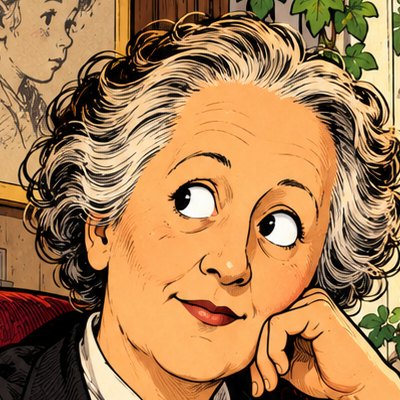
Meet Melanie Klein. Born in Vienna in 1882. She wanted to study medicine, but she married young, had three children, and spent years in an unhappy marriage, struggling with depression. While living in Budapest, she went into analysis with one of Freud’s closest colleagues, who noticed she had a gift for understanding children and encouraged her to start working with them.
So she did. With no university degree, no medical training and no permission from anyone, Melanie Klein became one of the most influential psychoanalysts of the twentieth century.
Her big innovation was simple and brilliant. Adults in psychoanalysis lie on a couch and say whatever comes into their head. Small children can’t do that. So Klein gave them toys instead: little people, houses, cars, animals. And she watched what they did. Who got crashed into what. Who got put to bed and who got thrown across the room. For Klein, children’s play was their free association. It showed what was going on inside.
And what she saw going on inside shocked people. The popular idea of babies was that they’re sweet, simple little creatures. Klein said: absolutely not. Babies have incredibly intense inner lives, full of love, rage, terror, greed and envy, right from the start. It’s just that they can’t tell anyone.
She lived a very dramatic life, too. She moved to London in 1926, became a star, and then got into a years-long war with Anna Freud, our birthday-present author from Level 1, about how to analyse children. The fights inside the British psychoanalytic society got so bitter that in the end it split into three groups: Klein’s followers, Anna Freud’s followers, and a group in the middle who refused to choose. One of those in the middle is our guest in the next chapter. Even her own daughter became a psychoanalyst and attacked her mother publicly at meetings. You couldn’t make it up. The woman who wrote about love and hate had more than enough of both at home.
So, what did she actually say? Let’s go back to the baby.
A newborn can’t understand that the person who feeds and holds it is the same person who sometimes isn’t there when it’s hungry. So, in its experience, there are two completely separate things. A wonderful, good one that brings milk, warmth and comfort. And a terrible, bad one that leaves it hungry, cold and screaming. The baby loves the first with everything it has, and hates the second with everything it has. That’s splitting. And it actually protects the baby: it keeps the good safe from the bad.
Klein called this first way of experiencing the world the paranoid-schizoid position. Scary name, simple idea: the world is split into heroes and villains, and the villains feel like they’re out to get you.
Then, from around the middle of the first year, something huge happens. The baby slowly realises: wait. The one I love and the one I hate… are the same person. And that realisation is painful. Because if you hate the same person you love, then your anger might have hurt the person you need most. So the baby feels something new: sadness, worry, and guilt. And a wish to make things better, to repair. Klein called this the depressive position. And no, “depressive” doesn’t mean being depressed. Yes, it’s another word we’ve been reading wrong. She meant the sad but grown-up moment of seeing someone as whole: good and bad together.
Klein didn’t call these “stages,” which you pass through once and leave behind. She called them positions, because we keep moving between them for the rest of our lives.
So the new manager who’s “amazing” in week one and “completely incompetent” in week two? That’s you sliding back into the paranoid-schizoid position: all good, then all bad. And the moment you can say, “she’s good at some things, she was harsh on my report, and both are true,” that’s the depressive position. That’s grown-up love. And grown-up dislike, too.
And that ugly little flash when your best friend got the job? Klein had a word for that too. Late in her life, she wrote about envy: not just wanting what someone else has, but wanting to spoil the good thing they have, precisely because it’s good. It’s one of the most uncomfortable ideas in psychoanalysis. And one of the most honest.
Empedocles: Love and Strife
Meet Empedocles. Sicily, around 450 BC. Philosopher, poet, doctor, politician, and, according to himself, a god. Ancient writers say he walked around in purple robes with a golden crown and bronze sandals, followed by crowds of admirers asking him for prophecies and cures. Modesty was not his main quality.
He wrote his philosophy as poetry, and most of it was lost. For centuries, we only had fragments, quoted by other writers. Then, in the 1990s, researchers in Strasbourg found more pieces of his poem on an ancient papyrus that had been sitting in a library collection, unnoticed, for almost a hundred years. So Empedocles is one of the few ancient philosophers who got new material released two and a half thousand years after his death.
And he had a huge influence. He’s the one who came up with the idea that everything is made of four basic elements: earth, water, air and fire. That idea ran Western science for about two thousand years. Every time you see a fantasy film with earth, water, air and fire powers, you’re watching Empedocles.
But the four elements aren’t the interesting part for us. The interesting part is what moves them. Because elements on their own just sit there. Empedocles said two forces push them around, and he gave them very human names.
Love, which pulls things together, mixes them, unites them.
And Strife, which pulls things apart, separates them, sets them against each other.
And these two forces, he said, are in a never-ending tug of war. When Love wins completely, everything melts together into one perfect, motionless sphere. Beautiful, but nothing happens in it. No separate things, no life, no stories. When Strife wins completely, everything is torn apart into separate piles of earth, water, air and fire. No mixing, no life either.
So where does the world we live in happen? In between. In the mix. Life only exists when Love and Strife are both at work, pulling and pushing at the same time.
He even had a wonderfully weird story about how living creatures appeared. At one point in the cycle, he said, there were body parts wandering around on their own: heads without necks, arms without shoulders, eyes looking for faces. Love started sticking them together, sometimes in the wrong combinations, giving you monsters like creatures with the head of an ox on a human body. The combinations that worked survived. Some people see it as a very, very early, very strange version of evolution.
Two and a half thousand years later, an old Viennese doctor was writing one of his last papers, and he mentioned Empedocles by name. Freud said he’d been delighted to discover that his own late theory, that human beings are driven by two great forces, one that brings things together and one that tears them apart, had already been described by a Greek poet in Sicily. Love and Strife. Freud called them by other names, but he admitted it was the same idea.
And Melanie Klein built her whole picture of the baby on exactly that idea: love and hate, pulling and pushing, from the very first day.
So the question is this: if Love and Strife run the whole universe, is it any surprise that they also run your relationship with your mum?
Can you love someone without hating them, at least a little?
Tonight: a Viennese-born psychoanalyst with a box of toys, versus a Sicilian poet in bronze sandals who said he was a god.
Where do love and hate come from?
So for Empedocles, love and hate are in the cosmos. For Klein, they’re in the cot.
So what’s the goal?
And look at that: they agree on something surprising. Neither of them thinks pure, perfect love is the goal. For Empedocles, pure Love is a frozen sphere. For Klein, pure love, where someone is all good, is just splitting, and the “all bad” is waiting on the other side.
What would they say to each other?
Imaginary, obviously. They missed each other by about 2,400 years.
So who wins?
No winner, but a really useful lesson for real life. Love and hate aren’t opposites that cancel each other out. They live together, in every close relationship, and that’s normal.
So next time you catch yourself flipping, from “she’s amazing” to “she’s terrible,” from “he’s perfect” to “how did I end up with him,” try asking: am I splitting? Can I hold both at once? The person who left the wet towel on the bed is the same person who made you laugh until you cried on Monday.
And remember what both of them would tell you. A relationship with no strife at all isn’t a perfect relationship. It’s a sphere where nothing happens. What really matters is whether, after the fight, you know how to come back together and repair.
Where you’ve already seen this
In plain words
The misunderstanding: On social media, “splitting” is often discussed mainly as a feature of borderline personality disorder, where it describes intense alternation between idealising and devaluing others. That clinical use is real, developed notably by Otto Kernberg. But the concept was first made central by Melanie Klein, who saw splitting as a normal part of every infant’s development. “Depressive position” does not mean depression; it describes the capacity to experience others as whole people, both good and frustrating.
Melanie Klein (1882–1960): Austrian-born British psychoanalyst and a founder of object relations theory. Without formal medical or university training, she pioneered child analysis using play as a substitute for free association. She moved to London in 1926. Her disagreements with Anna Freud led to the “Controversial Discussions” (1942–44) and the division of the British Psychoanalytical Society into Kleinian, Anna Freudian and Independent groups.
Klein’s key ideas:
- Infants have a rich inner world of unconscious phantasy from birth, with intense love and hate.
- Internal objects: the mind is populated by inner images of other people, starting with the earliest caregivers.
- Splitting: the infant divides experience into wholly good and wholly bad, keeping the good protected from the bad.
- Paranoid-schizoid position: a state dominated by splitting and projection, where bad feelings are experienced as coming from outside and threats feel persecuting (“Notes on Some Schizoid Mechanisms,” 1946).
- Depressive position: the recognition that the loved and hated person are the same, bringing guilt, sadness and the wish for reparation (papers of 1935 and 1940).
- These are positions, not stages: people move between them throughout life.
- Envy: the wish to spoil what is good because it is good, explored in Envy and Gratitude (1957).
Empedocles (c. 494–434 BC): Greek philosopher-poet from Akragas (Agrigento), Sicily. He proposed four “roots,” earth, water, air and fire, which became the classical four elements. Two forces act on them: Love (Philotes), which unites, and Strife (Neikos), which separates. The cosmos moves in a cycle: under total Love, everything merges into a motionless sphere; under total Strife, everything separates. The living world exists only in the mixture between them. Fragments of his poems were newly identified on the Strasbourg papyrus, published in 1999.
The connection: In “Analysis Terminable and Interminable” (1937), Freud compared his late theory of two fundamental drives, Eros and the destructive drive, to Empedocles’ Love and Strife. Klein built her theory of infant love and hate on Freud’s late drive theory.
Where they meet: Both see love and hate (or Love and Strife) as fundamental, permanent forces that cannot be eliminated, and both suggest that a purely harmonious state is neither possible nor desirable.
Where they differ: Empedocles describes Love and Strife as cosmic forces governing all of nature. Klein locates love and hate in the individual mind from birth, and sees psychological maturity in the integration of both towards the same person.
A note: Intense and persistent patterns of idealising and devaluing others that disrupt relationships are worth discussing with a mental health professional.
Further reading:
- Love, Hate and Reparation (1937) by Melanie Klein and Joan Riviere, a short, readable introduction to her ideas for a general audience.
- Melanie Klein: Her World and Her Work by Phyllis Grosskurth, a vivid biography.
- Any good collection of early Greek philosophical fragments, for Empedocles in his own words.
- Catullus, poem 85. Two lines. Read it in Latin and in translation.