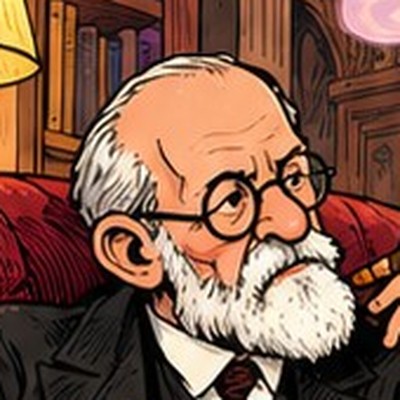
Why do I keep doing things that hurt me?
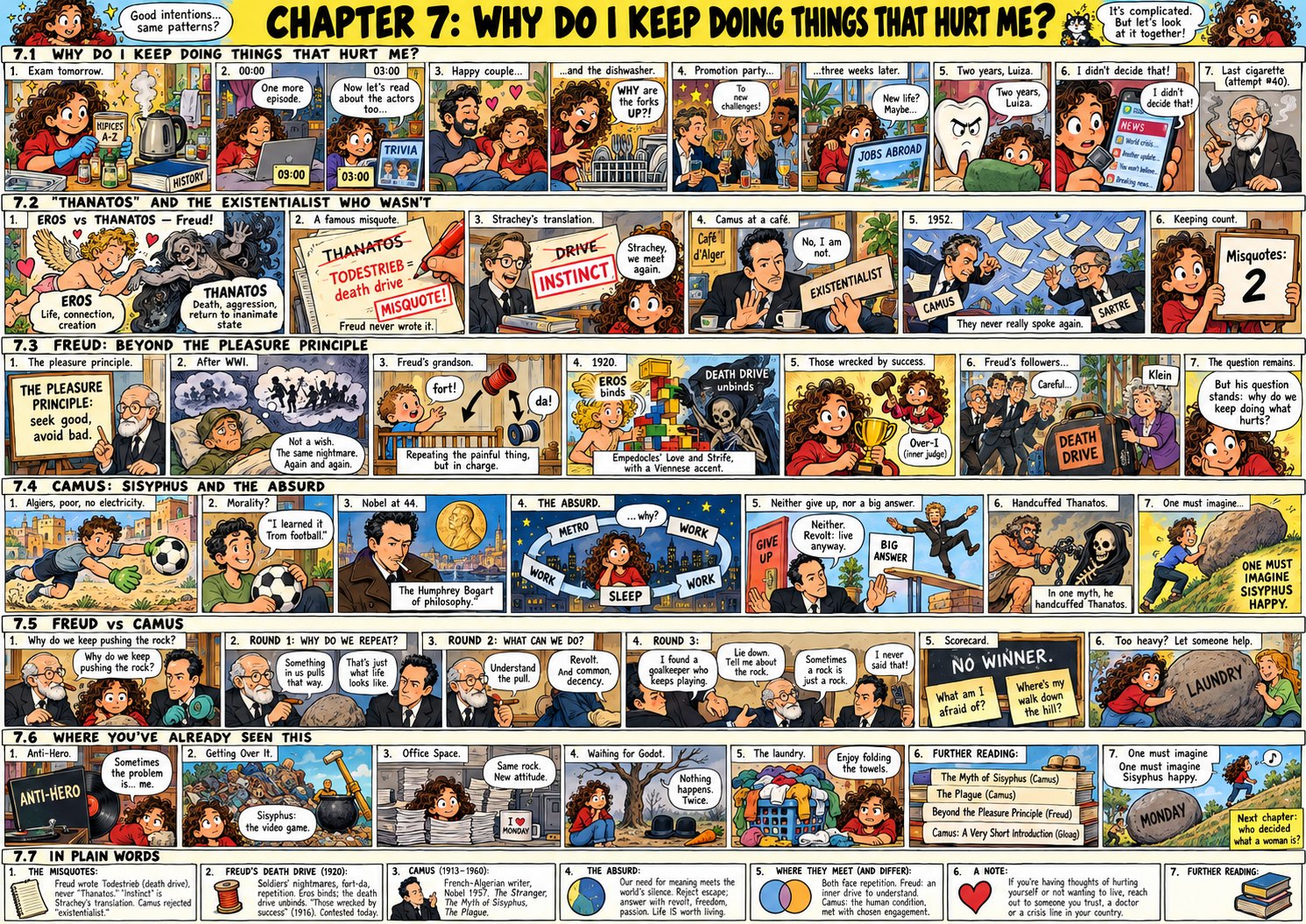
You have a big exam tomorrow. So naturally, tonight, you clean the entire flat. You descale the kettle. You alphabetise the spices. You’ve never been so productive in your life. About everything except the exam.
You have an important interview in the morning. You know you need sleep. It’s midnight. “One more episode.” It’s 3am. You’ve finished the season. You’re now reading about the actors.
Everything’s going really well with your partner. Calm, happy, easy. So, for reasons nobody can explain, including you, you start a fight about how they stack the dishwasher.
You finally get the promotion you worked towards for two years. Three weeks later, you’re looking at jobs in another country.
You’ve been putting off the dentist for two years. The tooth has noticed. The tooth is not happy. You’re still putting off the dentist.
You open the news app. It makes you feel terrible. You close it. Thirty seconds later, your thumb has opened it again. You didn’t even decide to.
And there’s always someone who announces their “last cigarette.” For the fortieth time. (Freud, we see you.)
In Level 1, we learned that the It follows the pleasure principle: I want what feels good, and I want it now. So why do we so often do the opposite? Why do we repeat things that hurt, avoid things that would help, and wreck things just as they start going well?
Freud’s answer is the darkest idea in all of psychoanalysis. And a French writer, on the other side of a world war, had an answer that was dark too, and then, surprisingly, very hopeful. It involves a man pushing a rock up a hill. Forever.
“Thanatos” and the existentialist who wasn’t
Crime number one. If you’ve read anything about Freud’s late theory, you’ve probably seen it described as a battle between Eros and Thanatos: love versus death, the life drive versus the death drive. Eros and Thanatos sound fantastic. Two Greek gods locked in eternal combat inside your head. Very cinematic.
Freud wrote about Eros. He never wrote “Thanatos.”
His German term was Todestrieb, which just means “death drive.” Plain German again, like “the It” and “the I.” The name “Thanatos,” the Greek god of death, was attached to it by other psychoanalysts. Freud’s biographer says Freud used it in conversation, but he never put it in his published work. So “Eros versus Thanatos,” the version on every poster, is half Freud and half fan fiction.
And while we’re here, our favourite translator returns. Freud’s word Trieb means “drive”: a pressure or a push. James Strachey translated it as “instinct,” which made it sound like something fixed and biological, like birds migrating. So in older English books, you’ll see “the death instinct,” which is not quite what Freud meant. Strachey, we meet again.
Oh, and “death wish”? Not Freud either. That one mostly comes from popular culture, including a very violent 1970s action film. Freud never wished anyone to call it that.
Crime number two. Albert Camus is constantly described as an existentialist, usually in the same breath as Sartre, our café philosopher from Level 1. They were friends, they both lived in Paris, they both wrote about freedom, meaning and absurdity, and they were both very famous at the same time. So the label stuck.
Camus hated it. He said, in an interview, quite plainly: no, I am not an existentialist. He thought existentialism had its own answers that he didn’t share, and he got very tired of being lumped in with Sartre.
And then, in 1952, they had one of the most famous friendship breakups in the history of philosophy. After Camus published a book criticising revolutionary violence, Sartre’s magazine published a brutal review of it, and then Sartre wrote a long, very personal open letter attacking Camus. They never really spoke again.
So the man who’s always called “the existentialist alongside Sartre” refused the label, and stopped talking to Sartre. Two for two.
Freud: Beyond the pleasure principle
For most of his career, Freud had one basic rule for the mind: the pleasure principle. We seek what feels good and avoid what feels bad. Even the strangest behaviour, he thought, could be traced back to some hidden wish for pleasure.
Then the First World War happened, and the rule stopped working.
Soldiers came home with what was then called “shell shock.” And many of them had the same nightmare, night after night: the explosion, the trench, the moment their friend was killed. Remember Level 1, when Freud said every dream is a wish? These dreams weren’t wishes. Nobody wishes to relive the worst moment of their life.
And it wasn’t just soldiers. Remember his grandson throwing the wooden reel out of his cot, fort, gone, again and again? Remember patients who repeated the same painful relationships over and over? Freud was seeing people return to pain, again and again, and the pleasure principle couldn’t explain it.
So in 1920, he wrote a short, strange, difficult book called Beyond the Pleasure Principle. And in it, he proposed something that shocked even his most loyal followers.
He suggested that there are two great forces in us. One he called Eros, the life drive: the force that connects, builds, joins things together into bigger and bigger wholes. Love, friendship, sex, families, cities. Sound familiar? It’s Empedocles’ Love, from chapter 2.
And the other is the death drive: a quieter force that pulls the other way. Towards undoing things, unbinding them, going back to stillness. Empedocles’ Strife, with a Viennese accent.
Most of the time, Freud said, the death drive is silent. We only see it when it’s mixed with something else. When it’s pointed outwards, it shows up as aggression and destruction, which is what he wrote about ten years later in Civilization and Its Discontents, our Level 1 chapter about the neighbour’s music. And when it’s pointed inwards, it shows up as the things at the start of this chapter: undermining yourself, repeating what hurts, wrecking the good thing, punishing yourself.
And he’d already spotted one of its most confusing forms a few years earlier. He wrote about people who fall apart at exactly the moment they finally get what they’ve always wanted. He called them “those wrecked by success.” The promotion you worked towards for two years, and then the urge to run away from it? Freud would say part of you may not feel allowed to have it. The Over-I, your harsh inner judge, sees you succeed and decides you need to be punished.
A sad note: early in 1920, while Freud was working on this book, his daughter Sophie died suddenly, during the flu epidemic. People have wondered ever since whether grief shaped the idea. Freud insisted it didn’t, and even asked a friend to confirm the book was already half-written. It’s one of those questions nobody can really answer.
The death drive is the idea that even Freud’s own followers backed away from slowly, like it was an unattended bag at an airport. Melanie Klein embraced it. Many others quietly dropped it. Most modern psychologists explain self-sabotage in other ways: fear of failure, fear of success, habits, guilt, the comfort of what’s familiar, or the brain choosing short-term relief over long-term good.
But Freud’s question still stands, and it’s a good one: if we’re supposed to want what feels good, why do we keep doing things that hurt?
Camus: Sisyphus and the absurd
Meet Albert Camus. Born in 1913 in French Algeria, into a very poor family. His father was killed in the First World War when Albert was still a baby. His mother cleaned houses, couldn’t read, and was partly deaf. They lived in a tiny flat with no electricity or running water.
As a teenager, his great love was football. He was a goalkeeper for a junior team in Algiers, and apparently a good one, until he got tuberculosis at seventeen and had to stop. Years later, when he was a world-famous writer, he said that most of what he knew about morality and duty, he’d learned from football. Which is the most relatable thing any philosopher in this course has ever said.
During the Second World War, he worked for a French Resistance newspaper. In 1957, at just forty-four, he won the Nobel Prize in Literature, one of the youngest people ever to receive it. Handsome, charming, usually photographed with a cigarette and a coat collar turned up, he was basically the Humphrey Bogart of philosophy.
His most famous essay, The Myth of Sisyphus, from 1942, starts with the biggest question there is: is life worth living, if it doesn’t come with a built-in meaning? And the whole book is his answer. Spoiler: yes.
To get there, he talks about the absurd. Here’s what he meant, in everyday terms. You get up. You take the metro. You work for four hours. Lunch. Metro. Four more hours. Dinner. Sleep. Monday, Tuesday, Wednesday, same rhythm. And most of the time, you don’t notice. But then, one day, maybe on the metro, maybe staring at a spreadsheet, a tiny question appears: why? Why am I doing all this?
That moment is the absurd. Camus said it’s not that the world is absurd, and it’s not that you are. It’s the clash between the two. We’re creatures who desperately want meaning, order and answers. And the universe just… doesn’t reply. We ask, and it says nothing. The absurd is that silence, meeting our question.
So what do you do once you’ve noticed?
Camus said there are two tempting ways to escape the question, and he rejected both. One is to give up on life. He said no to that, firmly: that’s not an answer to the absurd, it’s just running away from it. The other is to leap into a big ready-made meaning that explains everything, and stop asking questions. And yes, he specifically named our dizzy Danish friend Kierkegaard here: he thought the “leap” from Level 1 was a way of escaping the problem rather than facing it.
Camus’s answer was a third option: revolt. Not a revolution with flags. A personal, everyday refusal to give up. You look the absurd in the face, you admit there’s no guaranteed meaning written into the universe, and you live anyway. Fully, freely, passionately. You don’t need the universe’s permission to love your friends, enjoy the sea, play football, or care about other people.
And that’s where Sisyphus comes in.
In Greek myth, Sisyphus was a king who tricked the gods again and again. In one version, he even managed to chain up Death himself, so nobody on earth could die. Yes: he locked up Thanatos. Freud’s followers named the death drive after the god Sisyphus once put in handcuffs. As punishment, the gods condemned Sisyphus to roll a huge rock up a mountain. Every time he reaches the top, it rolls back down. And he has to start again. Forever.
It’s the ultimate image of pointless repetition. Your commute. Your inbox. Your laundry pile, which you will never, ever finish.
But Camus does something brilliant with it. He asks us to look at the moment Sisyphus walks back down the hill, after the rock has rolled away. In that moment, Camus says, Sisyphus knows exactly what his situation is. He’s not fooled. He has no hope of escape. And yet he walks down, and he picks up the rock again. And in that choice, he’s free. The rock is his. His fate belongs to him.
The book ends with one of the most famous lines in philosophy: One must imagine Sisyphus happy.
Not because the rock stops. It never stops. But because the struggle itself, chosen with open eyes, can be enough to fill a human heart.
Why do we keep pushing the rock?
Tonight: the man who smoked twenty cigars a day while writing about self-destruction, versus the man who said everything he knew about morality came from football.
Why do we keep doing things that hurt us?
So for Freud, the problem is inside you. For Camus, it’s the human condition, and the answer is inside you too.
So what can we actually do about it?
What would they say to each other?
Imaginary, of course. Freud died in 1939, just before Camus wrote The Myth of Sisyphus.
So who wins?
No winner, but two useful ways to handle your next round of self-sabotage.
Freud’s way: when you catch yourself alphabetising spices instead of studying, or starting a fight about the dishwasher just as things are going well, pause and ask: what am I afraid of here? Am I punishing myself for something? Sometimes the most honest answer is “I’m scared of getting what I want.”
Camus’s way: accept that some rock is always coming back. The laundry, the inbox, Monday. Stop waiting for the day the rock disappears. It won’t. Instead, choose it, and look for the walk back down the hill: the coffee, the friend, the song, the five minutes of sun. That’s not settling. That’s revolt.
And if the rock ever starts to feel too heavy to carry on your own, that’s exactly the moment to let someone else help you push.
Where you’ve already seen this
In plain words
The misquotes: Freud’s term was Todestrieb (“death drive”). He never used “Thanatos” in his published writings; the name was attached to the concept by other analysts, and his biographer Ernest Jones reported that Freud used it only in conversation. James Strachey’s translation of Trieb as “instinct” (hence “death instinct”) has been widely criticised; “drive” is closer. “Death wish” is a popular phrase, not Freud’s term. Albert Camus explicitly rejected the label “existentialist,” and his friendship with Jean-Paul Sartre ended publicly in 1952.
Freud’s death drive: In Beyond the Pleasure Principle (1920), Freud observed phenomena that seemed to contradict the pleasure principle: the repetitive nightmares of soldiers traumatised in the First World War, a child’s fort-da game repeating a painful absence, and patients’ compulsion to repeat painful experiences. He proposed two fundamental drives: Eros (the life drive), which binds and unites, and the death drive, a tendency towards undoing, unbinding and a return to an earlier, inanimate state. The death drive is largely silent, appearing when directed outwards as aggression or inwards as self-destructiveness, often via a harsh superego. Earlier, Freud had described “those wrecked by success,” who fall ill when a long-held wish is fulfilled (“Some Character-Types Met with in Psycho-Analytic Work,” 1916). Melanie Klein adopted the death drive; many later analysts rejected or reinterpreted it. Modern psychology generally explains self-sabotage through mechanisms such as fear of failure or success, guilt, habit, avoidance and the preference for short-term relief.
Albert Camus (1913–1960): French-Algerian writer, journalist and philosopher, raised in poverty in Algiers, editor of the Resistance newspaper Combat, and winner of the Nobel Prize in Literature in 1957. His works include The Stranger (1942), The Myth of Sisyphus (1942), The Plague (1947) and The Rebel (1951).
Camus on the absurd: In The Myth of Sisyphus, Camus begins by asking whether life is worth living, framing the question of suicide as the fundamental philosophical problem. His answer is that it is. The absurd arises from the confrontation between the human demand for meaning and the “unreasonable silence of the world.” Camus rejects both suicide and what he calls philosophical escape (a leap into a ready-made system of meaning, a charge he levels at Kierkegaard, among others). His response is revolt, freedom and passion: to live fully and lucidly without appeal to a guaranteed meaning. Sisyphus, condemned to push a boulder uphill forever, becomes the “absurd hero” because he is conscious of his fate and embraces it: “One must imagine Sisyphus happy.”
Where they meet: Both confront the human tendency to repeat, and both reject naive optimism about human happiness. Both ask how people can live with forces they cannot eliminate.
Where they differ: Freud locates the problem in an internal drive towards undoing, to be understood and worked through. Camus locates it in the human condition, the gap between our need for meaning and the world’s silence, and answers it with conscious, chosen engagement with life.
A note: This chapter discusses ideas from philosophy and psychoanalysis. If you are having thoughts of hurting yourself or of not wanting to live, please don’t carry that alone: reach out to someone you trust, a doctor, or a crisis line in your country. You deserve support.
Further reading:
- Camus’s The Myth of Sisyphus. Short, lyrical and much more hopeful than its reputation.
- Camus’s The Plague, a novel about people choosing to help each other in a situation they can’t control.
- Freud’s Beyond the Pleasure Principle (1920). Short but strange; read it after the New Introductory Lectures.
- Camus: A Very Short Introduction by Oliver Gloag.