Who decided what a woman is?
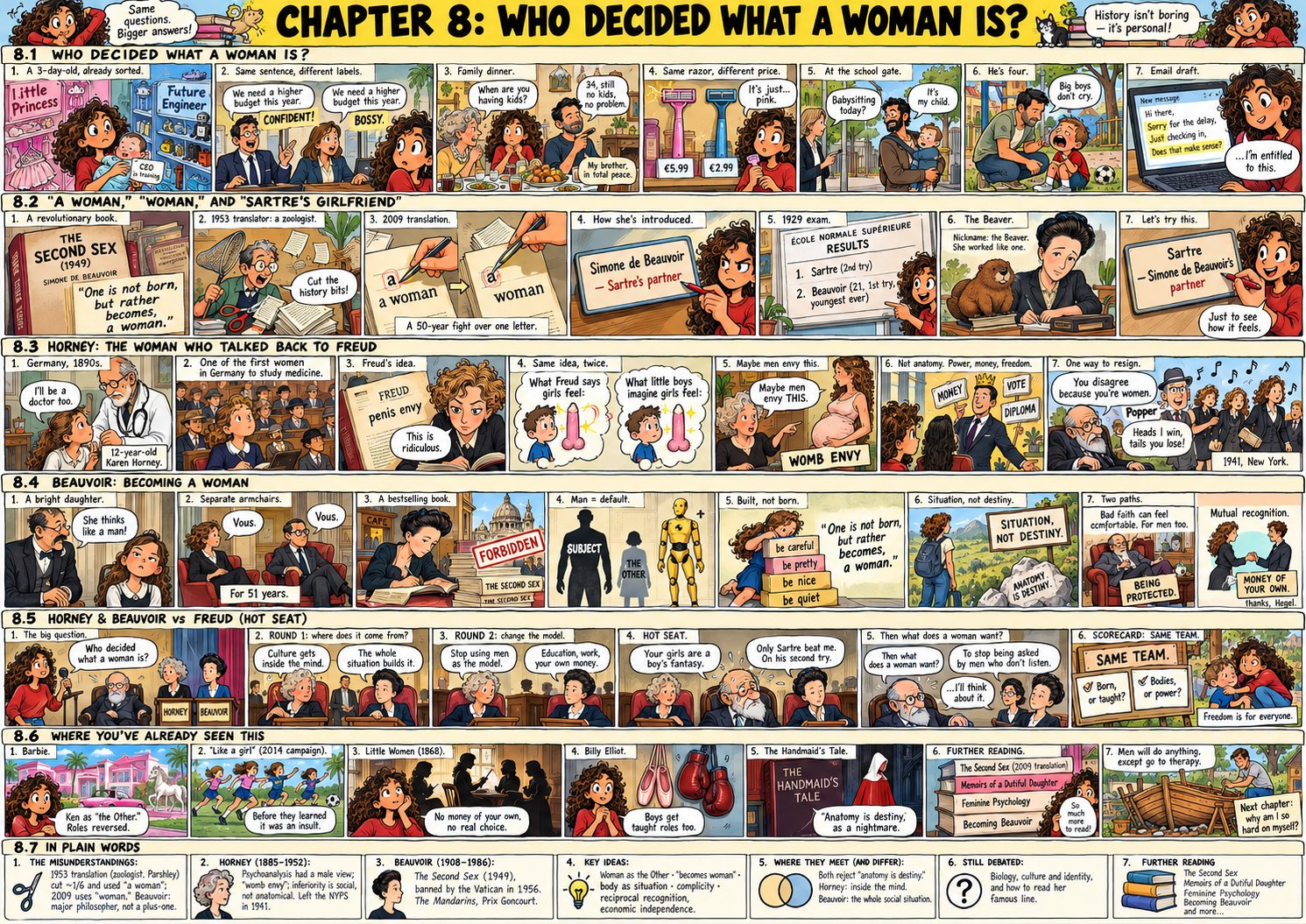
So who decided all this? Who decided pink was for girls and dinosaurs were for boys? Who wrote the rules about who’s bossy, who babysits and who’s allowed to cry?
Freud had an answer, and it was four words long: “Anatomy is destiny.” Your body decides who you are.
Two extraordinary women read that, and answered back. One was a psychoanalyst who told Freud, to his face, that he’d got women completely wrong. The other was a French philosopher who wrote a book so explosive that the Vatican banned it.
“A woman,” “woman,” and “Sartre’s girlfriend”
Crime number one. Simone de Beauvoir’s most famous line comes from her 1949 book The Second Sex. In English, you’ll usually see it as: “One is not born, but rather becomes, a woman.”
In French, it’s “On ne naît pas femme: on le devient.” And there’s a small word causing a big fight: “a.”
The first English translation came out in 1953. The funny part: the translator was a zoologist. A professor who studied animals and reproduction, chosen apparently because the publishers thought the book was mostly about sex and biology. It’s not. It’s a huge, dense work of philosophy, history and literature. The zoologist did his best, but he cut large chunks of it, about a sixth of the book, including long sections about women in history, and he often translated her philosophical vocabulary as if it were everyday language. For over fifty years, English readers were reading a shortened, simplified Beauvoir.
In 2009, a new, complete translation came out. And the translators made a choice: “One is not born, but rather becomes, woman.” No “a.” Because, they argued, Beauvoir wasn’t just talking about how one person grows up to be “a woman.” She was talking about how society creates the whole idea of “Woman,” with a capital W: what women are supposed to be, look like, want and do. Scholars are still arguing about which version is better. A whole debate, over one letter.
Crime number two. Beauvoir is almost always introduced the same way: “Simone de Beauvoir, Jean-Paul Sartre’s partner.” As if she were a plus-one at the philosophy party.
So let’s look at the results. In 1929, they both took France’s hardest national exam for philosophy teachers. Sartre came first. Beauvoir came second. But Sartre had failed the exam the year before, and this was his second attempt. Beauvoir passed at twenty-one, on her first try, the youngest person ever to pass it at the time. And according to accounts of the time, some of the examiners argued about whether she should have been placed first.
Her friends nicknamed her “the Beaver,” because “Beauvoir” sounds like the English word “beaver,” and because she worked like one. Some scholars now argue that several of the ideas usually credited to Sartre were developed with her, or by her first.
So maybe, next time, we introduce Sartre as “Simone de Beauvoir’s partner.” Just to see how it feels.
And if she was so brilliant, why did the Vatican ban her book? We’ll get there. But first, let’s meet the psychoanalyst who’d been fighting Freud on this for twenty years before Beauvoir even started writing.
Horney: The woman who talked back to Freud
Meet Karen Horney. Born near Hamburg, in Germany, in 1885. Her father was a strict, deeply religious sea captain. Her mother was more relaxed and more modern. When Karen was about twelve, a kind doctor treated her, and she decided, then and there, that she was going to be a doctor too.
This was not a normal plan for a girl in 1890s Germany. Universities had barely started letting women in. She did it anyway, and became one of the first women in Germany to study medicine. Then she trained as a psychoanalyst in Berlin, and became one of the first women to teach at the Berlin Psychoanalytic Institute.
And then she started reading what the men had written about women.
Remember Level 1: Freud’s theory that girls feel inferior because they don’t have a penis, and spend their lives envying boys. “Penis envy.” “Anatomy is destiny.” Horney read all this, and in 1926 she published a paper that said, politely but very clearly: this is ridiculous.
Her argument was brilliant. She pointed out that psychoanalysis had been created almost entirely by men, studying women from the outside. And she noticed that Freud’s picture of how little girls see themselves looked suspiciously similar to how little boys think about girls. In other words, Freud hadn’t discovered what girls feel. He’d written down what boys imagine girls feel.
Then she turned the whole thing around. If we’re talking about envy, she asked, what about men? Women can grow a human being inside their bodies, give birth and feed a baby. Men can’t. Maybe men envy that. She called it womb envy. And she suggested, quite cheekily, that maybe some of men’s endless need to build, conquer and achieve was a way of compensating. Adler from chapter 6 would have approved.
But her most important point was simpler. If women feel inferior, she said, it’s not because of their bodies. It’s because of their lives. They were less free, less paid, less educated, less listened to, and expected to depend on men. Of course they envied men. But what they envied wasn’t a body part. It was the power and freedom that came with being a man in that society.
In other words: it’s not anatomy. It’s culture.
And how did Freud respond? More or less, he suggested that women analysts who disagreed with his theory might be a bit biased because… they were women. Heads I win, tails you lose. Popper, from Level 1, would like a word.
In 1932, Horney moved to the United States, where she became a well-known writer and teacher. She wrote books for ordinary readers, not just experts, and she believed that, with some effort and honesty, people could even analyse themselves to a degree. That made the psychoanalytic establishment nervous. In 1941, the New York Psychoanalytic Society effectively pushed her out. The story goes that she and her supporters walked out of the meeting together, singing a spiritual about escaping from slavery. Which is one way to resign.
She went on to found her own institute, and to write about something we’ll meet in the next chapter: the voice in your head that’s constantly telling you what you should be. But her first fight, the one about women, opened the door for everyone who came after her.
Including a French philosopher in a café in Paris, who was about to write eight hundred pages on the subject.
Beauvoir: Becoming a woman
Meet Simone de Beauvoir. Born in Paris in 1908, into a proper, Catholic, upper-middle-class family that lost most of its money after the First World War. Her father was proud of how clever she was, and liked to say that Simone “thinks like a man.” He meant it as a compliment. She spent a large part of her life explaining why it wasn’t.
At fourteen, she stopped believing in God. At twenty-one, she came second in the national philosophy exam, ahead of almost everyone except Sartre on his second try. And she and Sartre began one of the most famous relationships in history. They never married. They never lived together. They had other lovers, openly. They wrote each other thousands of letters. And for fifty-one years, they addressed each other with vous, the formal French “you,” like two colleagues at a very long business meeting.
She wrote most of her work in Paris cafés, became a celebrated novelist, and in 1949 published The Second Sex, two volumes, around eight hundred pages. It sold tens of thousands of copies in its first week. It also made a lot of people furious. The Vatican put it on its list of forbidden books.
So what was in it?
Beauvoir’s first big observation is that, in almost every culture, men have been treated as the normal, default human being, and women as a variation on that. Man is the “Subject,” the one who acts and defines. Woman is the “Other,” defined in relation to him. Think of how often “people” secretly means “men”: in old medical research, in the design of offices and cars, even in crash-test dummies, which for a long time were modelled mainly on male bodies. Woman is the “and also.”
And here comes the famous line. One is not born, but rather becomes, a woman.
Remember Sartre in Level 1: “existence precedes essence”? There’s no fixed human nature you’re born with; you become who you are through your choices and your situation. Beauvoir took that idea and applied it to women. There’s no fixed “feminine nature” waiting inside a baby girl. Being “a woman,” in the social sense, is something you’re taught to become: by the pink aisle, by being told to be careful and pretty and nice, by being praised for being quiet and helpful while your brother is praised for being brave. By the time you’re grown up, it feels natural. It isn’t. It was built, day by day.
She didn’t say bodies don’t matter. She wrote a lot about bodies: pregnancy, ageing, sex. But she said a body is a situation, not a destiny. What it means to have that body depends on the world you live in. Freud’s four words, “anatomy is destiny”? Beauvoir took them apart.
And here’s where she’s braver than a lot of people expect. She said that sometimes women go along with being “the Other,” because it can be comfortable. Being protected, provided for and not responsible for your own life can feel easier than freedom. That’s Sartre’s bad faith, from Level 1. She said it applies to men too: plenty of men hide behind the role of “the man of the house” to avoid looking at their own lives.
And her solution? Remember Hegel’s master and slave from chapter 5? Beauvoir used that idea too. As long as one group is the master and the other is the Other, neither is really free, because the recognition the master gets is worthless. The way out is mutual recognition: men and women seeing each other as equally free people. For that, she said, women needed concrete things, especially work and financial independence, so they could make their own choices, rather than depending on someone else’s.
Seventy-five years later, people still argue about her famous sentence, about exactly what it means and how far it goes. That’s part of what makes it one of the most quoted lines in philosophy. Not bad for “Sartre’s girlfriend.”
Who decided what a woman is?
Tonight: a German doctor who walked out of the New York Psychoanalytic Society singing, versus a French philosopher who called her partner vous for fifty-one years.
Where do the differences come from?
So Horney looks at how culture gets inside the mind. Beauvoir looks at how culture builds the whole situation around a person.
So what should change?
Horney leans towards changing how we understand the mind. Beauvoir leans towards changing how we organise the world. They’d both say you need both.
And now, the hot seat
Imaginary, of course, but Freud was alive while Horney was publishing her papers, so this almost could have happened.
So who wins?
No winner between Horney and Beauvoir, because they’re on the same team, attacking from different directions. One from inside the mind, one from the shape of society.
And the next time you hear “that’s just how women are,” or “that’s just how men are,” you can borrow their questions.
Beauvoir’s question: is this something people are born with, or something they’re taught to become?
Horney’s question: is this really about bodies, or is it about power, money and who gets to do what?
And remember: it cuts both ways. The four-year-old boy told that “big boys don’t cry” is being taught what to become too. Beauvoir’s whole point was freedom, and freedom isn’t only for half the population. It’s for the girl in the pink aisle, the dad at the school gate who isn’t babysitting, and the little boy who just fell over in the park and is allowed to cry about it.
Where you’ve already seen this
In plain words
The misquotes and misunderstandings: Simone de Beauvoir’s line “On ne naît pas femme: on le devient” appears in The Second Sex (1949). The first English translation (1953), by the zoologist Howard Parshley, rendered it as “One is not born, but rather becomes, a woman,” and abridged the book substantially. The complete 2009 translation by Constance Borde and Sheila Malovany-Chevallier uses “One is not born, but rather becomes, woman,” emphasising the social category rather than an individual. Beauvoir is often introduced primarily as Jean-Paul Sartre’s partner; she was a major philosopher and novelist in her own right, and placed second to Sartre in the 1929 agrégation at 21, on her first attempt.
Karen Horney (1885–1952): German-American psychoanalyst, one of the first women to study medicine in Germany and to teach at the Berlin Psychoanalytic Institute. In papers such as “The Flight from Womanhood” (1926), she argued that psychoanalytic theories of female psychology reflected a male perspective, proposed that men may envy women’s capacity for pregnancy and motherhood (later called “womb envy”), and argued that women’s feelings of inferiority stem largely from social and cultural disadvantage rather than anatomy. She emigrated to the United States in 1932, was effectively expelled from the New York Psychoanalytic Society in 1941, and founded her own institute. Her later work on the “real self,” the “idealised self” and the “tyranny of the should” appears in Neurosis and Human Growth (1950).
Simone de Beauvoir (1908–1986): French existentialist philosopher, novelist and memoirist. Her major works include The Second Sex (1949), The Ethics of Ambiguity (1947) and the novel The Mandarins, which won the Prix Goncourt in 1954. The Second Sex was placed on the Vatican’s Index of Forbidden Books in 1956.
Beauvoir’s key ideas in *The Second Sex *:
- Woman has historically been defined as the Other in relation to man, who is treated as the default Subject.
- “One is not born, but rather becomes, woman”: femininity, in its social meaning, is produced through upbringing, culture and situation rather than given by nature.
- The body is a situation, not a destiny: its meaning depends on social context.
- Women may sometimes be complicit in their own subordination, in a form of what existentialists call bad faith.
- Drawing on Hegel’s master-slave dialectic, she argued for reciprocal recognition between the sexes, requiring concrete conditions such as education, work and economic independence.
Where they meet: Both rejected Freud’s claim that “anatomy is destiny” and argued that much of what was considered natural about women was in fact shaped by culture and social position.
Where they differ: Horney worked within psychoanalysis, focusing on how cultural conditions shape individual psychology and inner conflict. Beauvoir worked within existentialist philosophy, focusing on freedom, the social construction of “woman” as a category, and the concrete changes needed for women to live as free subjects. Debates continue today about the relationship between biology, culture and identity, and about how Beauvoir’s famous line should be interpreted.
Further reading:
- Beauvoir’s The Second Sex, ideally the complete 2009 translation. Start with the Introduction and the chapter “Childhood” at the start of Volume II.
- Beauvoir’s Memoirs of a Dutiful Daughter (1958), her vivid account of growing up.
- Horney’s Feminine Psychology (1967), a collection of her papers on women.
- Becoming Beauvoir by Kate Kirkpatrick, a recent biography that reassesses her relationship with Sartre and her own philosophical contribution.