Why do I lie to myself?
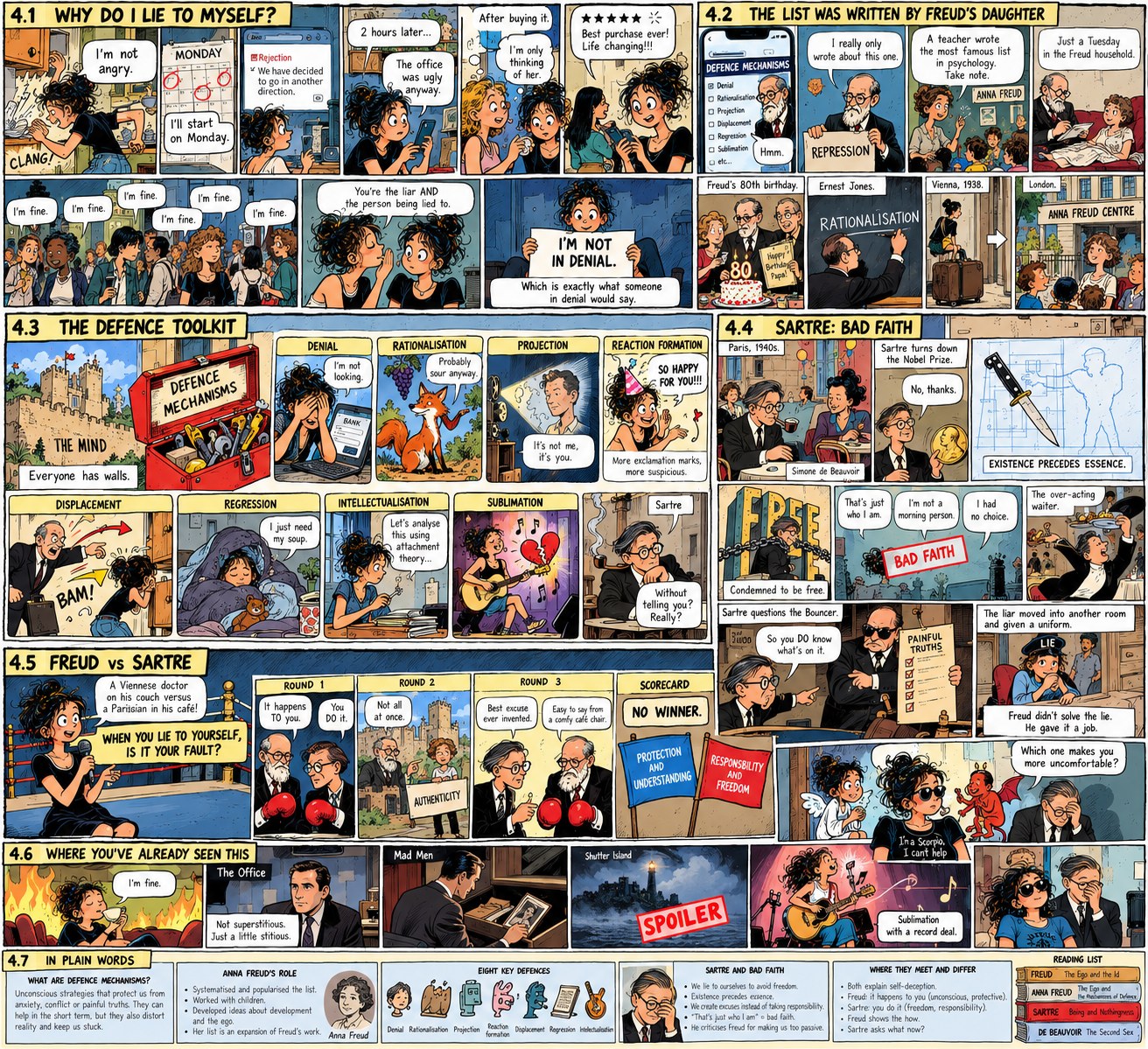
“I’m not angry.” You say this while closing a cupboard so hard the plates rattle.
“I’ll start on Monday.” It’s the fourth Monday.
You didn’t get the job. Two hours later: “Honestly? I didn’t even want it. The office was ugly anyway.”
Your friend just got engaged and you’re suddenly very worried about her. “I’m just saying, it’s quite fast. I’m only thinking of her.”
You bought something expensive you didn’t need. Now you’re reading five-star reviews of it. Not before buying it. After.
And the classic, said by millions of people every single day: “I’m fine.”
We lie to ourselves constantly. We’re really good at it. We’re the easiest audience in the world, because we want to believe us.
But wait. Stop and think about it for a second, because it’s actually really strange. To lie to someone, you need to know the truth and hide it from them. So when you lie to yourself, you’re both the liar and the person being lied to. You have to know the truth and not know it at the same time.
How is that even possible?
Two very different thinkers tried to answer that. One said: part of you is hiding the truth from another part, and you have no idea it’s happening. The other said: oh, please. You know. You’re choosing not to look.
Let’s find out who’s right. And let’s start with “I’m not in denial.” Because that’s exactly what someone in denial would say.
The list was written by Freud’s daughter
Search “defence mechanisms” online and you’ll find hundreds of colourful lists. Denial! Projection! Repression! Usually with a little illustration of Freud next to them. “Freud’s defence mechanisms,” they say.
Well. Freud did talk about defence. Very early in his career, he noticed that his patients’ minds seemed to be protecting themselves from painful thoughts. For years he focused mainly on one way of doing that: repression, our bouncer from chapter 2. Later, he admitted repression was just one of several tricks the mind uses.
But he never sat down and wrote the list. That was his daughter.
Meet Anna Freud. The youngest of Freud’s six children. And, you’ll like this, she started out as a primary school teacher. She taught young children in Vienna before becoming a psychoanalyst herself. So yes: the most famous list in psychology was written by a teacher. Take note, everyone.
Now, a slightly awkward detail. Anna was psychoanalysed by her own father. For years. Today, that would get any therapist struck off immediately. Back then, it was just a Tuesday in the Freud household.
In 1936, Anna published a book called The Ego and the Mechanisms of Defence, and gave it to her father for his 80th birthday. Most people give their dad socks. Anna gave hers a founding text of modern psychology. In it, she carefully listed and explained the different ways the I protects itself from things it can’t handle: repression, projection, reaction formation, sublimation and more. She’s the one who turned her father’s scattered ideas into the organised toolkit everyone quotes today.
And a few of the famous ones didn’t come from either Freud. “Rationalisation,” for example, the art of finding good reasons for things you did for bad ones, was named by Freud’s colleague and biographer, Ernest Jones.
Two years after the book came out, the Nazis took over Austria. Anna was arrested and questioned by the Gestapo. Shortly after, the family escaped to London, where she spent the rest of her life working with children, including children orphaned or traumatised by the war. The centre she founded in London still exists today.
So next time you see a list of defence mechanisms with a picture of Sigmund on it, you know who really wrote it.
The defence toolkit
First, one important thing. For Freud and Anna, defence mechanisms aren’t bad. They’re protection. Your mind is like a castle, and these are its walls. Without them, every painful truth would hit you at full force, all day long. Everyone uses them. The problem only starts when the walls get so thick you can’t see out.
And the key feature: they happen unconsciously. You don’t wake up and think, “Today I will project.” It just happens. That’s what makes them so hard to catch.
Let’s open the toolkit.
So there it is. Your mind, quietly protecting you from the truth, without asking your permission, and without telling you it’s doing it.
At least, that’s the Freud family’s version. Because a French philosopher in a café in Paris was about to say: “Without telling you? Really? Come on.”
Sartre: Bad faith, or “you know exactly what you’re doing”
Meet Jean-Paul Sartre. Paris, 1940s. Very small, very short-sighted, one eye pointing slightly off to the side, pipe permanently in hand. He wrote most of his books sitting in cafés, because his apartment was freezing during the war. He was in a lifelong open relationship with another famous philosopher, Simone de Beauvoir, who you’ll definitely meet later in this course. And in 1964, he was awarded the Nobel Prize in Literature, and turned it down. Who does that? Sartre does that.
Sartre was an existentialist, and his big idea goes like this. A knife is made for cutting. Someone designed it with a purpose before it existed. But humans? Nobody designed you. You exist first, and then you decide what you are through your choices. He put it as “existence precedes essence.” Which is a fancy way of saying: there’s no fixed “real you” hiding inside. You are what you do.
Sounds freeing, right? It is. It’s also terrifying. Because it means you can’t blame your nature, your personality, your star sign or your childhood for what you choose. Sartre said we are “condemned to be free.” We never asked for this freedom, but we’re stuck with it.
And because freedom is so scary, we constantly try to escape it. We lie to ourselves about it. Sartre called this bad faith.
Bad faith sounds like: “That’s just who I am.” “I’m not a morning person.” “I had no choice.” “It’s my job, I’m just following the rules.” “I’m like this because of how I was raised.” Every sentence that turns you into a thing with a fixed nature, instead of a person who is choosing.
His most famous example is a waiter in a café. This waiter is just a bit too waiter-ish. His movements are too quick, too precise, he bends a little too eagerly, carries the tray a little too dramatically. He’s performing “waiter.” Sartre says he’s playing at being a waiter, as if a waiter is all he is, because being a thing is so much easier than being free. If he’s just a waiter, he doesn’t have to face the fact that he could walk out tomorrow and do anything.
Then Sartre goes straight for Freud. He looks at the bouncer from chapter 2, the one who decides which thoughts are allowed in and which are kept out. And he asks: how does the bouncer know who to keep out? To stop a painful thought at the door, the bouncer has to recognise it. He has to know it’s painful. So the bouncer knows the truth. Which means somewhere inside you, you know. Freud didn’t solve the problem of lying to yourself. He just moved the liar into a different room and gave him a uniform.
Sartre’s conclusion: you’re not a victim of your unconscious. You’re choosing not to look. And deep down, you know it.
Rude? Yes. But also a bit hard to argue with.
When you lie to yourself, is it your fault?
Tonight: a Viennese doctor on his couch versus a Parisian philosopher in his café.
Who’s actually doing the lying?
So for Freud, lying to yourself is something that happens to you. For Sartre, it’s something you do.
So what do we do about it?
Freud (with Anna nodding along): Slowly, carefully and with help, you learn to notice your defences and understand what they’re protecting you from. And you don’t tear all the walls down at once. They were built for a reason. Some of them were keeping you standing.
What would they say to each other?
Imaginary, as always, though this one’s close to real, since Sartre actually wrote his attack on Freud.
So who wins?
No winner, but a very useful difference in tone. Freud is the kind friend: “It’s not your fault, but it might be worth looking at.” Sartre is the brutally honest friend: “It’s your choice. Stop pretending it isn’t.”
And honestly? Most people need both friends. Freud to understand why you’re doing it. Sartre to stop you using that understanding as another excuse.
So let’s go back to the start. “I’m not in denial.” Freud says: you might genuinely not know. Sartre says: oh, you know.
Which one feels more uncomfortable to you? That might be your answer.
You’ve seen this before
No-jokes box
Defence mechanisms: Unconscious processes the ego uses to protect itself from anxiety, painful feelings or unacceptable impulses. Freud introduced the idea of defence early on (“The Neuro-Psychoses of Defence,” 1894), focused for years mainly on repression, and later described repression as one defence among several (Inhibitions, Symptoms and Anxiety, 1926).
Anna Freud (1895–1982): Freud’s youngest child, a former primary school teacher who became a leading psychoanalyst and pioneer of child analysis. Her book The Ego and the Mechanisms of Defence (1936) systematised the defences and made them central to psychoanalytic theory. She emigrated to London in 1938 and founded the clinic now known as the Anna Freud Centre. The term “rationalisation” was introduced by Ernest Jones in 1908.
Key defences:
- Denial: refusing to acknowledge an obvious reality.
- Rationalisation: giving acceptable reasons for behaviour driven by other motives.
- Projection: attributing one’s own unacceptable feelings or impulses to others.
- Reaction formation: replacing an unacceptable feeling with its exaggerated opposite.
- Displacement: redirecting a feeling from its real target to a safer one.
- Regression: returning to behaviour typical of an earlier developmental stage.
- Intellectualisation: handling emotional material through abstract reasoning to avoid feeling it.
- Sublimation: channelling impulses into socially valued activities; generally considered the healthiest defence.
Jean-Paul Sartre (1905–1980): French existentialist philosopher, novelist and playwright. He argued that humans have no fixed nature (“existence precedes essence”) and are radically free and responsible for their choices (“condemned to be free”), ideas set out in Being and Nothingness (1943) and Existentialism Is a Humanism (1945). He declined the Nobel Prize in Literature in 1964.
Bad faith (mauvaise foi): Sartre’s term for self-deception in which a person denies their own freedom, for example by treating themselves as a fixed object (“that’s just who I am”) or by claiming they had no choice. His examples include the café waiter who over-performs his role.
Sartre’s critique of Freud: In Being and Nothingness, Sartre argued that the Freudian censor must know what it is repressing in order to repress it, so self-deception cannot be explained by dividing the mind into conscious and unconscious parts. For Sartre, self-deception happens within a single consciousness that is, at some level, aware of what it avoids.
Where they meet: Both treat self-deception as real, common and central to human life, and both see recognising it as a path to greater freedom.
Where they differ: For Freud, self-deception is largely unconscious and protective, and must be explored patiently, often with help. For Sartre, it is a choice for which we are responsible; the answer is authenticity, not interpretation.
Where to go next:
- Anna Freud’s The Ego and the Mechanisms of Defence (1936). Clear and surprisingly short.
- Sartre’s Existentialism Is a Humanism, a short lecture and the easiest way into his thinking.
- The chapter on bad faith in Being and Nothingness, for those ready for something harder.
- Existentialism: A Very Short Introduction by Thomas Flynn.
Homework