What was that dream about?
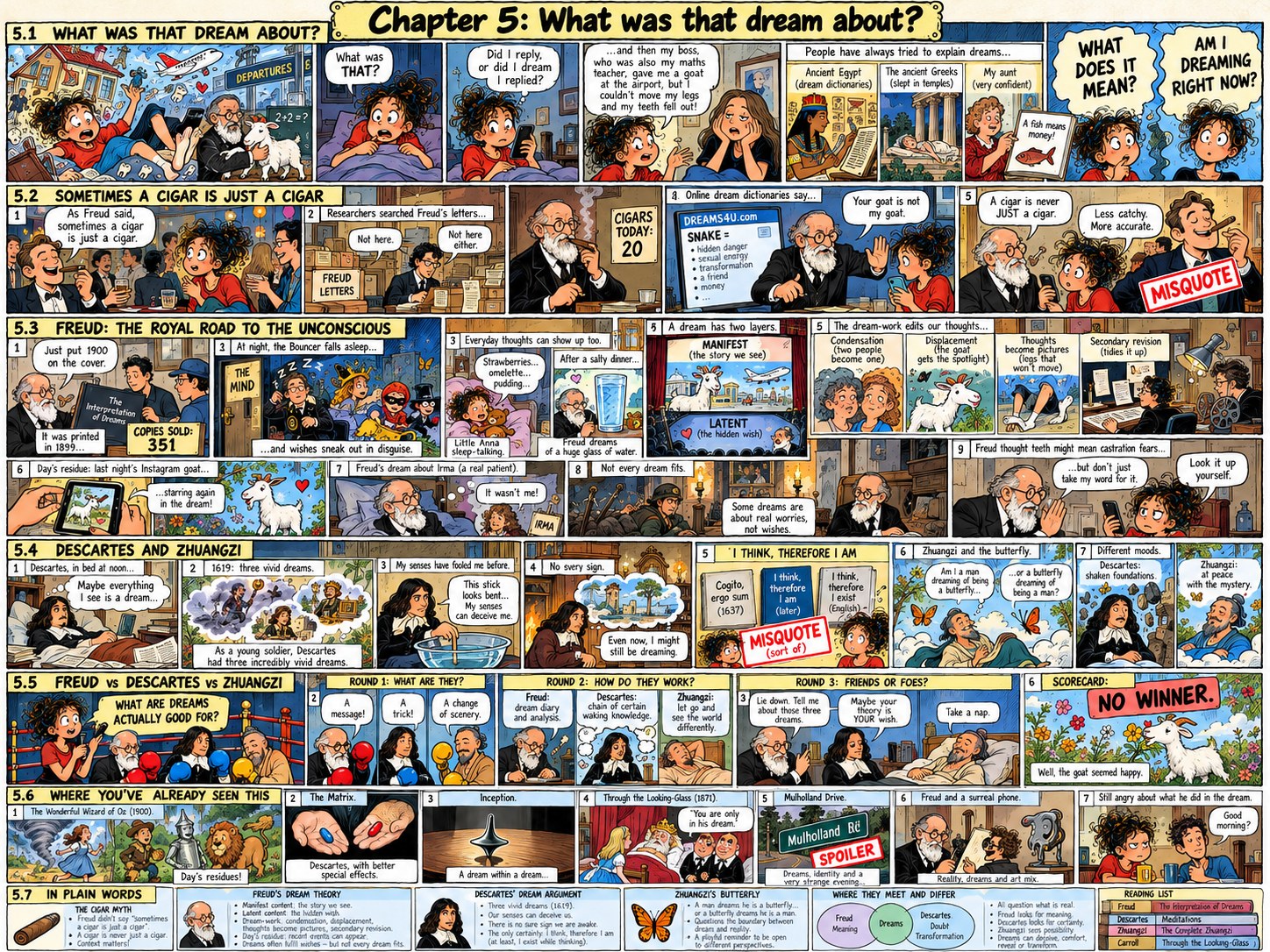
Last night you were in your childhood home. Except it was also an airport. Your boss was there, but she was also your old maths teacher, and for some reason she was holding a goat. You needed to catch a flight but your legs wouldn’t move. Then your teeth started falling out.
You wake up. Heart racing. You lie there staring at the ceiling thinking: what was THAT?
Or the other kind. You wake up and you’re genuinely not sure whether something happened or not. Did I reply to that email, or did I dream I replied to that email? Did he actually say that, or was that the dream? You check your phone just to be sure.
And then there’s the worst part of any dream: telling someone about it. “Okay so I was in this house, but it wasn’t my house, it was like my house but different…” And you watch their face slowly lose the will to live. Dreams are the most fascinating thing in the world, but only to the person who had them.
Humans have always been obsessed with dreams. Ancient Egyptians wrote dream dictionaries. Greeks slept in temples hoping the gods would send them one. Your aunt still thinks dreaming about fish means someone’s pregnant.
And there are really two big questions about dreams.
The first one: what does this dream mean? Why the goat? Why the teeth? Why is my boss also my maths teacher?
The second one is stranger, and a lot creepier: how do I know I’m not dreaming right now?
A Viennese doctor spent years on the first question. A French philosopher and a Chinese philosopher asked the second one. And by the end of this chapter, you may never fully trust being awake again.
“Sometimes a cigar is just a cigar”
You’ve heard it. Someone reads too much into something, and a clever person says: “Well, as Freud said, sometimes a cigar is just a cigar.”
It’s perfect. It’s funny. It’s wise. And there’s no evidence that Freud ever said it.
Researchers have gone through his books, his essays, his letters, his lectures. It’s not there. The line only started appearing decades after his death, and it’s been attributed to him ever since, mostly because it sounds exactly like something he should have said.
Now, the cigar part is very real. Freud was completely obsessed with cigars. He smoked around twenty a day. Even after he developed cancer of the mouth and jaw, went through more than thirty operations and had to wear a prosthetic in his mouth, he kept smoking. Doctors begged him to stop. He didn’t. If anyone ever needed a session with Freud about his relationship with cigars, it was Freud.
The fake quote is interesting anyway, because people use it to say: “Relax, not everything has a hidden meaning.” And that’s actually the opposite of Freud’s view of dreams. For Freud, pretty much nothing in a dream was random. The goat, the airport, the teeth: all of it meant something.
What he did not believe was that it meant the same thing for everyone. You know those websites where you type in “dream about snakes” and it tells you exactly what it means? Freud was mostly against that. He said the meaning depends on you: your memories, your day, your worries, what comes to your mind when you think about that goat. Your goat is not my goat.
So the real Freud would say something more like: “A cigar is never just a cigar. But it doesn’t mean the same thing in your dream as it does in mine.”
Less catchy. Much more accurate.
Freud: The royal road to the unconscious
In November 1899, Freud published the book he always considered his greatest: The Interpretation of Dreams. But he asked the publisher to print the date as 1900, because he wanted it to belong to the new century. Very dramatic. The new century was not impressed. The book sold 351 copies in six years.
In it, Freud called dreams “the royal road” to the unconscious. Remember the bouncer from chapter 2? At night, when you’re asleep, he gets tired. He doesn’t go home, but he gets lazy. So things from the entrance hall start sneaking out. Not openly, though. They sneak out in disguise.
And Freud’s big claim is this: every dream is a wish.
With young children, you can see it clearly. When Anna Freud, yes, our Anna from chapter 4, was a toddler, she was sick one day and wasn’t allowed to eat. That night, she was heard talking in her sleep, listing her favourite foods: strawberries, wild strawberries, omelette, pudding. Hungry child, dream about food. Simple.
Freud even tested it on himself. When he ate salty food in the evening, he’d dream he was drinking cool water. Thirsty body, dream about drinking. The wish comes true, at least for one night.
“Fine,” you say, “but I don’t wish my teeth would fall out. And I definitely didn’t wish for a goat.”
That’s where the disguise comes in. Adult wishes are often ones the Over-I from chapter 3 would never allow. So the dream disguises them before they get past the bouncer. Freud said every dream has two layers. There’s the manifest content: the story you remember. The airport, the goat, the teeth. And there’s the latent content: the hidden wish underneath.
The process that turns one into the other, he called the dream-work. And it uses tricks like an editor making a very strange film.
And the raw material? Often bits of your day. Freud called them the day’s residues. That goat might just be a goat you saw on Instagram before bed. The trick is asking why that goat made it into the film.
So how do you decode it? Not with a dream dictionary. You take each piece, one at a time, and ask yourself: what comes to mind when I think about this? And you keep going. The meaning comes from your associations, not from a website.
The first dream Freud fully analysed was his own. A patient of his, called Irma, wasn’t getting better, and in the dream it turned out her illness was someone else’s fault. His wish? It wasn’t me. Very relatable.
And to be fair to him, Freud did eventually admit that not every dream fits. After the First World War, he saw soldiers who kept reliving the same horrific moments in their nightmares, again and again. That wasn’t a wish. It made him rethink his whole theory, which you’ll hear about much later in the course.
Oh, and the teeth falling out? Freud had a very Freudian theory about that one. I’ll let you look it up yourself.
Descartes and Zhuangzi: How do you know you’re awake right now?
Meet René Descartes. French, born in 1596. Mathematician, scientist, philosopher, and famously not a morning person. As a sickly child at school, he was allowed to stay in bed late, and he kept the habit for life, lying in bed until late morning, thinking. Some of the most important ideas in Western philosophy were born under a duvet.
His whole career started with dreams. One cold November night in 1619, as a young soldier in Germany, he had three vivid dreams in a row, and he became convinced they were telling him his life’s mission: to rebuild all of human knowledge from scratch. So Freud wasn’t the first genius to take his own dreams very seriously.
Years later, in 1641, Descartes wrote Meditations on First Philosophy, where he tries a bold experiment. He decides to doubt everything he possibly can, to see if anything is left that’s completely certain.
He starts with his senses. They’ve fooled him before: a stick looks bent in water, a tower looks round from far away. So he can’t fully trust them.
Then he goes further. He’s sitting by the fire, in his dressing gown, holding a piece of paper. Surely that’s certain? But then he remembers: he’s had dreams exactly like this. Dreams where he was sure he was sitting by the fire, fully dressed, when actually he was lying in bed asleep. And he realises there’s no clear sign that separates being awake from being asleep. Everything that feels real now also felt real in the dream.
So how does he know he’s not dreaming right now? He doesn’t. And neither do you.
This is the famous dream argument, and it’s the reason Descartes eventually lands on his most famous idea: even if I’m dreaming, even if everything is fake, there’s one thing I can’t doubt. I’m the one doing the doubting. So I must exist. You know it as “I think, therefore I am.”
And yes, it’s this course, so of course that one’s quoted slightly wrong too. The famous line first appears in French in an earlier book, Discourse on the Method, as “je pense, donc je suis.” The Latin “cogito, ergo sum” that everyone quotes comes from a later book. In the Meditations themselves, he says it differently: “I am, I exist.” Still, full points for the idea.
Now, travel back almost 2,000 years earlier, to ancient China, and meet Zhuangzi. A Daoist philosopher, known for being funny, strange and very relaxed about everything.
One night, Zhuangzi dreamed he was a butterfly. He was flying around happily, enjoying himself, with no idea that he was Zhuangzi. Then he woke up, and there he was, solid and unmistakably Zhuangzi.
And then he asked: was I Zhuangzi dreaming I was a butterfly? Or am I now a butterfly dreaming I’m Zhuangzi?
It’s the same question Descartes asked, but look at the difference in mood. Descartes is alarmed. For him it’s a problem, a crack in the foundations, something he has to fix before he can trust anything.
Zhuangzi? He’s delighted. He doesn’t try to solve it at all. For him, it’s a reminder that the line between things is softer than we think, that everything is constantly changing into something else. Maybe it doesn’t really matter which one is the dream. The butterfly was happy. That’s enough.
Descartes wants certainty. Zhuangzi wants to float.
What are dreams actually good for?
Tonight: a Viennese doctor with a notebook full of dreams, a French philosopher who refuses to get out of bed, and a Chinese sage who may or may not be a butterfly.
What is a dream?
So what should we do with our dreams?
What would they say to each other?
Imaginary, and this time across three continents and about 2,300 years.
So who wins?
Three thinkers, three completely different attitudes. For Freud, a dream is a message about you. For Descartes, a dream is a warning about how easily you can be fooled. For Zhuangzi, a dream is just life doing what life does: changing shape.
So next time you wake up from the airport-goat-teeth dream, you’ve got options. You can analyse it like Freud. You can use it to question reality like Descartes. Or you can shrug, like Zhuangzi, and think: well, the goat seemed happy.
You’ve seen this before
No-jokes box
“Sometimes a cigar is just a cigar”: There is no evidence Freud said or wrote this. The line appears only decades after his death (see Alan Elms, “Apocryphal Freud,” 2001). Freud did smoke heavily, was diagnosed with oral cancer in 1923, underwent more than thirty operations and continued smoking until his death in 1939.
Freud’s dream theory: Set out in The Interpretation of Dreams (published November 1899, dated 1900), which Freud considered his most important work. His core claims:
- Dreams are wish fulfilments. In young children the wishes appear openly; in adults they are usually disguised.
- Every dream has manifest content (the dream as remembered) and latent content (the hidden thoughts and wishes behind it).
- The dream-work transforms latent into manifest content through condensation (merging several elements into one), displacement (shifting emotional importance onto minor details), considerations of representability (turning thoughts into images) and secondary revision (making the dream more coherent on waking).
- Dreams draw on day’s residues, fragments of recent experience.
- Dreams are interpreted through the dreamer’s own free associations, not fixed symbol dictionaries, though Freud accepted a small number of typical symbols in later editions.
- He called dream interpretation “the royal road to a knowledge of the unconscious” (added in 1909).
- He later acknowledged that repetitive traumatic nightmares did not fit the wish-fulfilment theory (Beyond the Pleasure Principle, 1920).
René Descartes (1596–1650): French philosopher and mathematician. In the First Meditation of Meditations on First Philosophy (1641), he argues that because dreams can be indistinguishable from waking experience, the senses cannot provide certainty: the dream argument. This leads him to the one thing he cannot doubt, his own existence as a thinking thing. “Je pense, donc je suis” appears in Discourse on the Method (1637); “cogito, ergo sum” in Principles of Philosophy (1644). In the Sixth Meditation he offers a practical test: waking experiences connect with the rest of our lives through memory, while dreams do not.
Zhuangzi (c. 4th century BC): Chinese Daoist philosopher. In the butterfly dream (chapter 2 of the Zhuangzi), he wakes from dreaming he was a butterfly and cannot tell whether he is a man who dreamed of being a butterfly or a butterfly dreaming of being a man. He uses it to illustrate the “transformation of things,” the fluid boundaries between states of being, rather than as a problem to solve.
Where they meet: All three treat dreams as revealing something important: about the self (Freud), about the limits of knowledge (Descartes), or about the nature of reality and change (Zhuangzi).
Where they differ: Freud asks what dreams mean and treats them as disguised truths about the dreamer. Descartes asks whether we can know we are awake and uses dreams to show the unreliability of the senses. Zhuangzi embraces the uncertainty rather than resolving it.
Where to go next:
- Freud’s On Dreams (1901), his own short summary of The Interpretation of Dreams. A much easier starting point.
- Descartes’ Meditations, especially the First Meditation. Only a few pages.
- The Zhuangzi, chapter 2. Burton Watson’s translation is widely read and very accessible.
- Lewis Carroll’s Through the Looking-Glass, for fun.
Homework