Did I mean to say that?
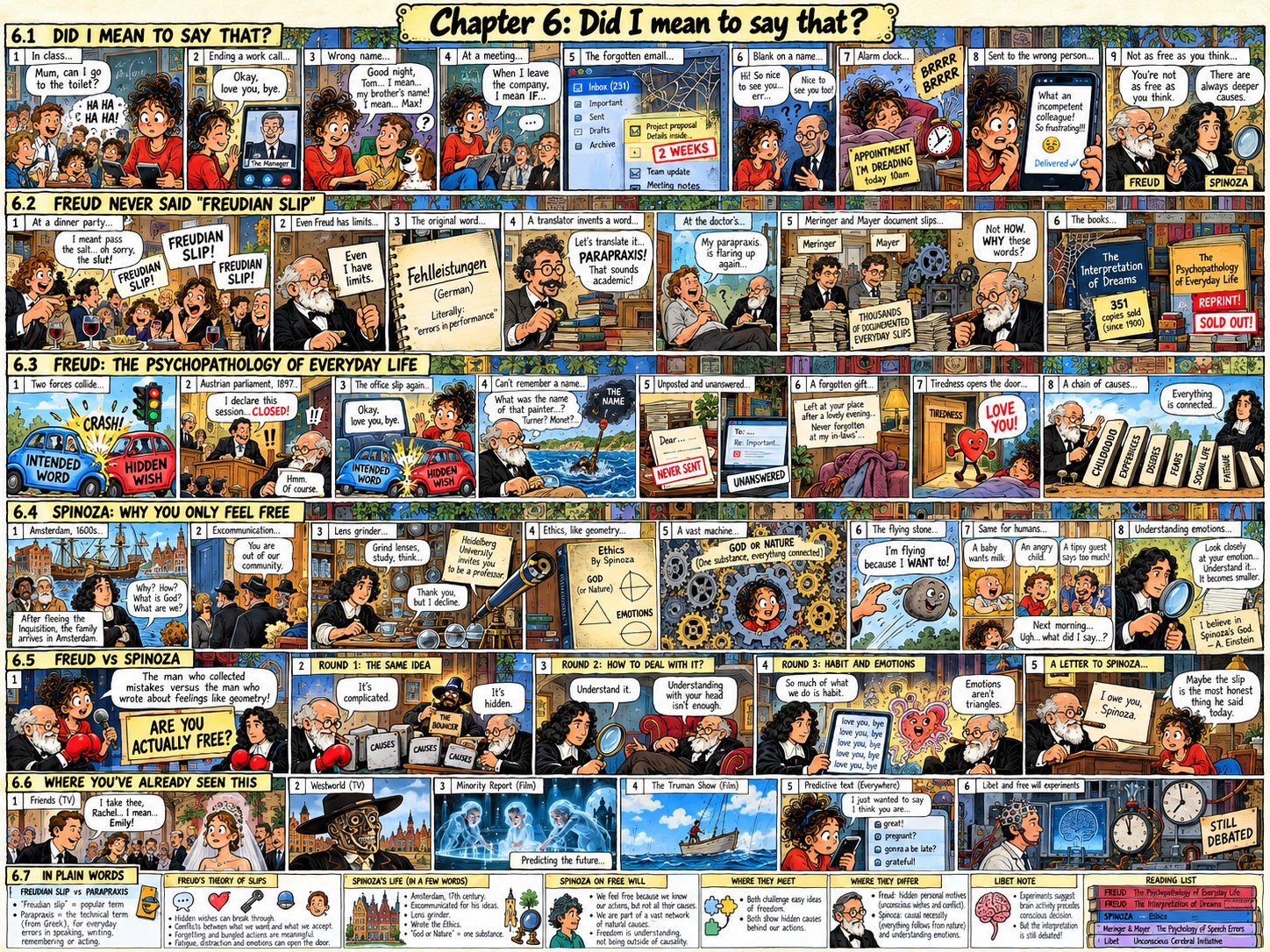
Every teacher knows this moment. A student puts their hand up, totally focused, and says: “Mum, can I go to the toilet?” The whole class explodes. The student wants to disappear into the floor. And the teacher, if she’s read any Freud, is quietly taking notes.
You’ve done a version of it too. You’ve ended a work call with “Okay, love you, bye.” To your manager.
You’ve called your partner by your brother’s name. Or the dog’s.
You’re in a meeting talking about next year’s plans and you say “when I leave the company, I mean, if, if I leave…” Everyone pretends they didn’t hear. Everyone heard.
You answer every email in your inbox, quickly and efficiently. Except one. That one’s been sitting there for two weeks, and you keep “forgetting” it.
You completely blank on the name of someone you’ve met five times. Oddly, it’s always the one you don’t really like.
You sleep through your alarm. Not on a normal day. On the day of the appointment you were dreading.
And the nightmare: you write a message complaining about a colleague, and you send it… to that colleague.
So, are these just accidents? Tiny glitches, like a computer freezing for a second? Or are they messages, little flashes of something you really think, sneaking out when you’re not looking?
And if your own mouth can say things you didn’t decide to say… how much of what you do say, and do, are you actually deciding?
That’s where things get uncomfortable. Because one Viennese doctor and one Dutch lens-grinder, 250 years apart, both came to the same conclusion. You’re not as free as you think.
Freud never said “Freudian slip”
It’s one of the most famous phrases in the English language. You say the wrong word, everyone laughs, and someone says: “Ooh, Freudian slip!”
Freud never used it. Obviously, he wasn’t going to name something after himself. Even Freud had limits. Not many, but some.
In German, he called these mistakes Fehlleistungen. It literally means something like “faulty performances” or “failed actions.” Plain, everyday German, the same way he said “the It” and “the I” in chapter 3.
And what did his English translators do? Exactly what they did last time. They swapped the everyday word for a scientific-sounding one. They invented the word parapraxis. Say it out loud: parapraxis. It sounds like a skin condition. It sounds like something you’d need antibiotics for. Nobody in the history of the world has ever said “ooh, parapraxis!” at a dinner party.
So normal people ignored it and started saying “Freudian slip” instead. Which means the most famous term connected to Freud was invented by the public, not by Freud and not by his translators.
And, of course, Freud wasn’t the first to study slips either. A few years before him, a linguist called Rudolf Meringer and a psychiatrist called Carl Mayer collected hundreds of slips of the tongue and published them. Their explanation? Mechanics. Sounds get mixed up, similar words get confused, the brain trips over itself. Nothing more.
Freud read their work and said: interesting collection, completely wrong conclusion. For him, the question wasn’t how the words got mixed up. It was why these words. Why “love you” and not “see you”? Why “when” and not “if”? The mistake isn’t random. It’s showing you something.
He put all of this in a book in 1901, called The Psychopathology of Everyday Life. The Interpretation of Dreams sold 351 copies in six years. This one, about ordinary people forgetting names and losing keys, became one of his most popular books ever, reprinted again and again during his lifetime. Turns out people are much more interested in their own embarrassing moments than in theory. Which, honestly, is the whole idea behind this course.
Freud: The psychopathology of everyday life
Freud’s big idea about slips is simple, and a little bit scary: in the mind, nothing happens by accident.
When you make a slip, he said, two intentions are crashing into each other. There’s the thing you meant to say. And there’s another thing, a thought or wish you’ve been pushing down, that wants to be said instead. Most of the time the first one wins. But when you’re tired, distracted or stressed, the second one sneaks through, sometimes completely, sometimes as a strange mix of both.
His favourite example is about politics. The president of the Austrian parliament stood up to open an important session and announced, very formally, that the session was now… closed. Everyone laughed. Freud didn’t. He pointed out that the president was expecting nothing good from that session and would have loved it to be over before it started. His mouth simply said what he wished.
Sound familiar? “When I leave the company, I mean, if, if I leave…” Same crash. Your official plan says “if.” Something else in you has already said “when.”
Freud found this pattern everywhere, not just in speech.
Now, to be fair, Freud did accept that tiredness, distraction and habit play a role. Being exhausted makes slips much more likely. But he insisted that tiredness only opens the door. It doesn’t decide which word walks through it. You were tired, fine. But why “love you” to your manager, and not “see you”?
And notice what this means. If even your tiny mistakes have causes you didn’t choose, then maybe your bigger choices do too. Freud believed the mind works like the rest of nature: everything has a cause, even when you can’t see it. And that idea brings us to a philosopher who believed exactly the same thing, 250 years earlier, and took it much, much further.
Spinoza: Why you only feel free
Meet Baruch Spinoza. Amsterdam, 1600s. His family were Portuguese Jews who had fled the Inquisition and found safety in the Netherlands. Young Baruch was brilliant, and he started asking questions. Too many questions. At 23, his own community formally expelled him with one of the harshest excommunications on record. Nobody was allowed to speak to him, stay under the same roof, or read anything he wrote.
So what did he do? He moved away, lived very simply, and earned his living grinding glass lenses for microscopes and telescopes. He was actually very good at it. When the University of Heidelberg offered him a prestigious professorship, he turned it down, because he was worried he wouldn’t be free to think what he wanted. He died at 44, probably partly because of years of breathing in fine glass dust.
His masterpiece, the Ethics, was only published after his death. And it’s written in the strangest way possible: like a geometry textbook. Definitions, axioms, propositions, proofs, like he’s proving a triangle has three sides. Except the triangle is God, the universe and your emotions.
His big idea: everything in the universe is part of one single, connected system, which he called “God or Nature.” And in that system, everything happens because of causes. Nothing happens randomly. Not the weather, not the planets, and not you.
So what about free will? Spinoza’s answer is famous. He said we think we’re free because we’re aware of what we want, but we’re not aware of what’s causing us to want it.
He gave a brilliant example in a letter. Imagine you throw a stone. It flies through the air. Now imagine that stone suddenly became conscious in mid-air. It would feel itself moving, and it would think: “I’m flying because I want to fly.” It has no idea someone threw it. That, Spinoza says, is the human freedom everyone’s so proud of.
In a passage of the Ethics that could have come straight out of Freud’s book on slips, Spinoza lists people who feel completely free when they’re clearly not. The baby who thinks it freely wants milk. The angry child who thinks it freely wants revenge. And the drunk person who thinks they’re freely choosing what to say, and then, the next morning, wishes they’d never said it.
Two hundred and fifty years before Freud, Spinoza was already describing the “love you, bye” moment.
But Spinoza isn’t a gloomy “nothing is free” philosopher. He didn’t stop there. He said real freedom is possible, just not the kind we imagine. It doesn’t mean escaping causes. It means understanding them. The more clearly you understand why you feel what you feel, the less those feelings control you. He wrote that an emotion that’s controlling you stops controlling you as soon as you form a clear idea of it.
Now think about Freud. Bring the hidden thing into the light, and it loses its power. Spinoza said it first.
Oh, and one more fan: when someone asked Albert Einstein if he believed in God, he answered that he believed in Spinoza’s God. Not bad for an excommunicated lens-grinder.
Are you actually free?
Tonight: a Viennese doctor who collected other people’s mistakes versus a Dutch lens-grinder who wrote about emotions like geometry.
Where do our choices really come from?
For once, they agree. You’re the flying stone. The difference is in why you can’t see what threw you. For Spinoza, it’s simple ignorance: the causes are just too many and too complicated. For Freud, it’s worse: some of the causes are being actively hidden from you, by you.
So can we become free?
What would they say to each other?
Imaginary, as always. Spinoza died in 1677, about 180 years before Freud was born.
So who wins?
A rare near-agreement. Both say you’re less free than you think. Both say that the only real path to freedom is understanding what’s driving you. Where they split is how you get there: Spinoza by clear reasoning, Freud by digging, feeling and talking.
Late in his life, Freud admitted in a letter that he owed a lot to Spinoza’s ideas, even though he’d never quoted him. Which, if you’ve been following this course, is extremely on-brand for Freud.
So next time you say “when I leave the company, I mean, if,” don’t just laugh it off. Both of these men would tell you the same thing: that little slip might be the most honest thing you said all day.
You’ve seen this before
No-jokes box
“Freudian slip”: A popular term Freud never used. His German word was Fehlleistung (“faulty performance”), translated in the English Standard Edition as “parapraxis.” Slips of the tongue had already been collected and explained mechanically by Rudolf Meringer and Carl Mayer (Versprechen und Verlesen, 1895); Freud accepted their examples but rejected their explanation.
Freud’s theory of parapraxes: Set out in The Psychopathology of Everyday Life (1901) and the Introductory Lectures on Psycho-Analysis (1916–17). Slips of the tongue and pen, misreadings, forgetting names or intentions, losing and mislaying objects, and bungled actions result from interference between a conscious intention and a disturbing, often repressed, one. Fatigue, distraction and habit make slips more likely but do not determine their content. Freud held that nothing in mental life is truly random, a view often called psychic determinism. Key examples include the Austrian parliament president who opened a session by declaring it closed, and Freud’s own forgetting of the painter Signorelli’s name.
Baruch Spinoza (1632–1677): Dutch philosopher of Portuguese Jewish descent, excommunicated from Amsterdam’s Jewish community in 1656. He earned his living grinding optical lenses and declined a professorship at Heidelberg in 1673 to protect his intellectual freedom. His Ethics (published posthumously, 1677) is written in geometric form and identifies God with Nature (Deus sive Natura): a single system in which everything follows necessarily from causes.
Spinoza on free will: People believe they are free because they are conscious of their desires but ignorant of their causes (Ethics, Appendix to Part 1). Examples include the infant wanting milk and the drunk who speaks “freely” and later regrets it (Part 3, Proposition 2, Scholium), and the thrown stone that, if conscious, would believe it flies by its own will (Letter 58). Genuine freedom is not escape from causation but understanding it: a passive emotion ceases to be a passion once we form a clear and distinct idea of it (Part 5, Proposition 3).
Where they meet: Both are determinists about the mind: human thoughts and actions have causes, many of them outside awareness. Both see understanding those causes as the path to greater freedom. Freud acknowledged a debt to Spinoza in a 1931 letter to Lothar Bickel.
Where they differ: For Spinoza, we fail to see causes mainly because they are complex; clear reasoning can free us. For Freud, some causes are actively kept from awareness through repression, and intellectual insight alone is not enough to change them (“’Wild’ Psycho-Analysis,” 1910).
A note on science: Benjamin Libet’s experiments in the 1980s, suggesting brain activity precedes conscious decisions, are often cited in debates about free will, but their interpretation remains contested.
Where to go next:
- Freud’s The Psychopathology of Everyday Life (1901). His most readable book, full of real-life stories.
- Spinoza’s Ethics, Appendix to Part 1. A short, surprisingly lively entry point before the harder sections.
- Spinoza: A Very Short Introduction by Roger Scruton.
- Betraying Spinoza by Rebecca Goldstein, a lively, story-like introduction to his life and ideas.
Homework