God is dead... now what?
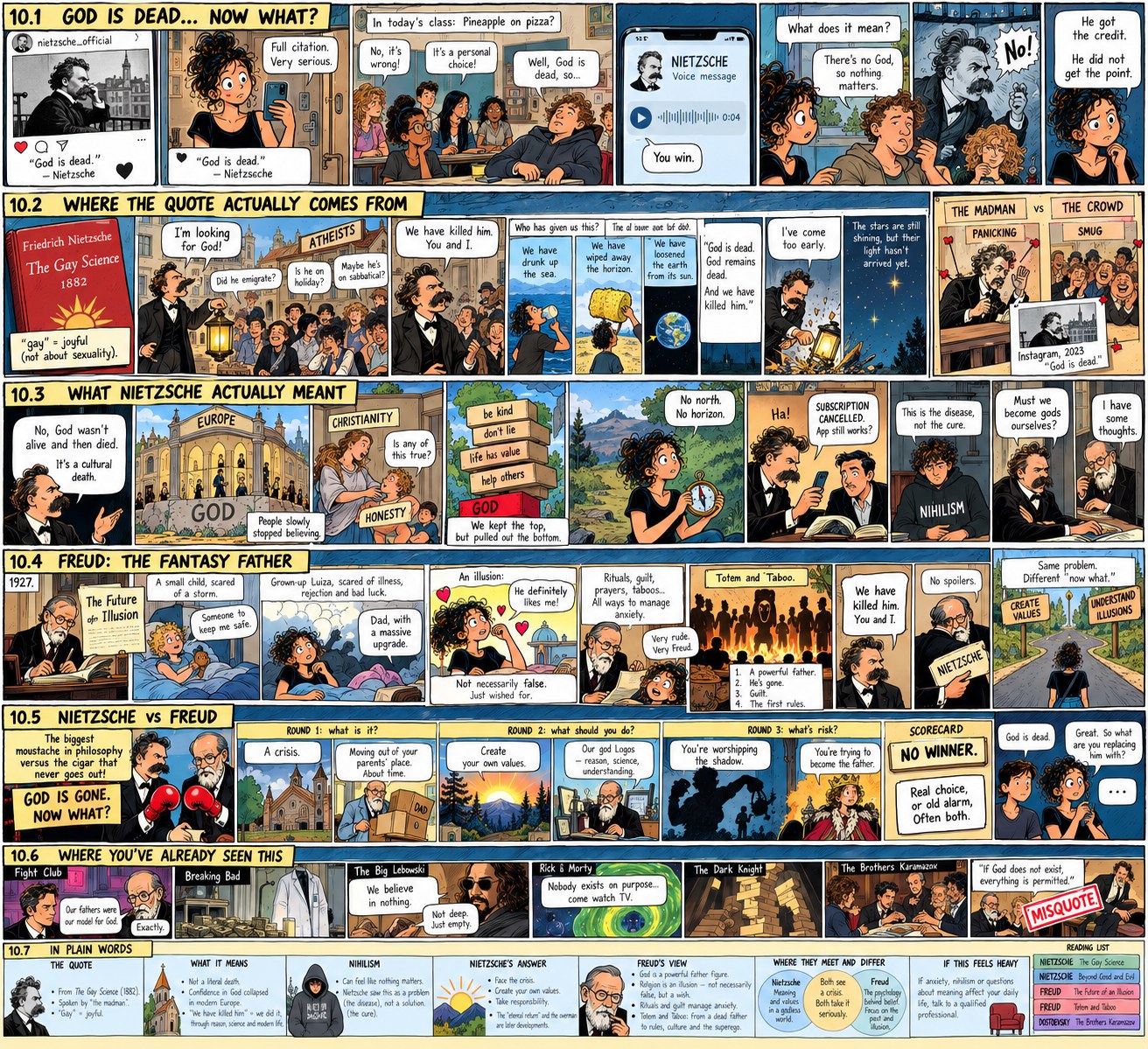
Open Instagram right now and I promise you’ll find it. A black-and-white photo. Someone staring out of a rainy window, or smoking on a balcony, or standing very still in a leather jacket. And the caption: “God is dead.” — Nietzsche. Proper quotation marks, full credit, very serious. Because nothing says “I’ve read philosophy” like citing your source under a mirror selfie.
Then I go to work. I teach teenagers, and they love a debate. Any debate. School uniforms, homework, pineapple on pizza. And at some point, usually when someone is losing, out it comes: “Well, God is dead, so…” And they say it like it ends the conversation. Like Nietzsche personally left them a voice note saying they win.
So I ask what it means. And the answer is almost always: “There’s no God, so nothing matters and you can do whatever you want.”
Which is funny, because the man who wrote it would have been horrified. He got the credit. He did not get the point.
Nietzsche didn’t write “God is dead” as a mic drop, or as a caption for your balcony photo. He wrote it as a warning. So today we’re finding out what he actually said, why it scared him, and why Freud looked at the same problem a few decades later and came to a completely different conclusion.
Where the quote actually comes from
First, let’s find where the body was found.
“God is dead” isn’t from a speech or a tweet or a motivational poster. It’s from a book called The Gay Science, published in 1882. And no, not that kind of gay. In 1880s German it meant something closer to “joyful.” Nietzsche would be very confused by your Pride month content.
The famous line appears in a tiny section called “The Madman,” and it’s basically a short story.
A man lights a lantern in the middle of a bright morning and runs into the marketplace shouting, “I’m looking for God! I’m looking for God!”
Now, the people in the marketplace are not believers. That’s the twist nobody mentions. They’re atheists. They already don’t believe in God. So they start making fun of him. Did God get lost? Is he hiding? Did he go on holiday? Did he emigrate? Everyone’s laughing.
And the madman turns to them and says: “Where is God? I’ll tell you. We have killed him. You and I. All of us are his murderers.”
Then he asks them a series of questions that sound absolutely terrifying. How did we drink up the whole sea? Who gave us the sponge to wipe away the horizon? What did we do when we unchained the Earth from its sun? Aren’t we falling now, in every direction? Isn’t it getting colder?
And then comes the line: “God is dead. God remains dead. And we have killed him.”
Nobody says anything. So he throws his lantern on the ground, it smashes, and he says: “I’ve come too early. My time hasn’t come yet.” This huge event has already happened, he says, but people haven’t noticed it yet. Like light from a distant star that hasn’t reached us.
So let’s review the evidence. The person saying “God is dead” is not cool. He’s not smug. He’s not winning a debate. He’s panicking in public. And the people who are smug and relaxed and think the whole God thing is no big deal? Those are the people Nietzsche is making fun of.
Which means, if you post “God is dead” with a smirk and a cigarette emoji, you’re not the madman. You’re the guy in the marketplace laughing at him.
What Nietzsche actually meant
Okay, so first things first: Nietzsche is not saying God was a real being who was alive and then died. He didn’t believe in God. He’s also not saying “yay, no more God.” He’s saying something much more awkward.
What he means is: for over a thousand years, Europe’s whole way of life was built on belief in God. Where morality comes from, why life has meaning, what’s true, what’s good, why you shouldn’t lie or steal or kill. All of it rested on God. And by the 1800s, educated people had quietly stopped believing. Science, history, philosophy, all of it had made God harder and harder to believe in.
That’s the “we killed him” part. Nobody stabbed anybody. We did it by thinking. Ironically, Nietzsche argued that Christianity itself trained people to be obsessed with truth and honesty, and eventually that honesty turned around and asked, “wait, is any of this actually true?” Christianity raised the kid who ended up questioning it.
Now think of it like Jenga. God was the block at the very bottom. People pulled it out, and the tower is still standing, for now. Everyone’s still walking around saying “be kind,” “don’t lie,” “every human life has value,” “there’s a purpose to all this.” But the thing holding those ideas up is gone. And nobody’s looking down.
That’s why the madman’s questions are so dramatic. Drinking up the sea, wiping away the horizon, unchaining the Earth from the sun. They’re all about losing your fixed point. If there’s no horizon, how do you know which way is up? If there’s no sun, what are we even orbiting? Without God, what are our values anchored to?
Nietzsche actually made fun of people who thought they could just delete God and keep everything else the same. He had a go at English writers in particular, who dropped Christianity but held on even tighter to Christian morality, as if nothing had changed. For him, that’s like cancelling your subscription and expecting the app to keep working.
And what was he afraid of? A word you’ve probably seen on a hoodie: nihilism. The feeling that nothing matters, nothing has value, nothing is worth doing. He saw it coming for Europe and he thought it would be a disaster.
So, for the debate kids: when you say “God is dead, so nothing matters and you can do whatever you want,” that’s not Nietzsche’s point. That’s the problem Nietzsche was worried about. You’re describing the disease and calling it the cure.
His real question was: if the old foundation is gone, can we build a new one ourselves? The madman even asks it: don’t we now have to become gods ourselves, just to be worthy of what we’ve done? That’s a huge ask. And whether we can actually pull it off is where Freud walks in and says, “hmm, I have some thoughts.”
Freud: The fantasy father
About 45 years after the madman smashes his lantern, a Viennese doctor with a cigar and a beard sits down and writes a book about God. It’s called The Future of an Illusion, published in 1927, and Freud’s question is different from Nietzsche’s. Nietzsche asked “what happens now that God is gone?” Freud asks “why did we need God in the first place?”
And his answer is: because we were children once.
Think about being very small. You’re completely helpless. The world is huge and scary, and the only thing standing between you and total chaos is your parents, especially, in Freud’s world, your father. He’s big, he’s strong, he protects you, he sets the rules, and sometimes he punishes you.
Then you grow up and discover something awful: you’re still helpless. Not against the dark under your bed anymore, but against illness, natural disasters, bad luck and, eventually, death. So what does the adult brain do? It brings Dad back. Just bigger. All-powerful, all-knowing, living in the sky, protecting you, setting the rules, and sometimes punishing you. For Freud, God is basically your father with a massive upgrade.
Now, careful with the word “illusion,” because Freud uses it in a specific way. An illusion, for him, isn’t necessarily false. It’s a belief we hold because we really, really want it to be true. Believing your crush is secretly into you is an illusion. They might be! But that’s not why you believe it. You believe it because you want it. That’s Freud’s point about religion: the problem isn’t that it’s been proven false, it’s that the wish is doing all the work.
Freud even compared religion to a kind of shared obsessive neurosis for the whole of humanity. The rituals, the rules, the guilt, the need to do things exactly right or something bad will happen. He saw the same patterns in his patients. Very rude, very Freud.
And now the weird coincidence. Years before this, in 1913, Freud wrote a book called Totem and Taboo, where he made up a story about the very beginning of human society. In it, there’s a primal father who controls the whole group. His sons get fed up, band together and kill him. Then they feel horribly guilty, and out of that guilt come the first rules, the first rituals and the first religion.
So Freud also tells a story where we kill the father, and the guilt that follows shapes everything. Sound familiar? “We have killed him. You and I.”
Freud later admitted that he’d avoided reading Nietzsche for a long time, because Nietzsche’s ideas were so close to his own that he didn’t want to be influenced. Which is the academic version of not watching a show because you’re scared it’s better than the one you’re writing.
So Freud and Nietzsche agree that God is fading. They agree it’s a big deal. But when it comes to “now what?”, they want completely different things. And that’s the fight.
God is gone. Now what?
Welcome to the debate of the century. In one corner, a German philosopher with the biggest moustache in intellectual history. In the other, a Viennese doctor with a cigar he absolutely refuses to put down.
What’s the problem?
For Nietzsche, losing God is a crisis. For Freud, it’s more like moving out of your parents’ house. Stressful, but it’s what adults do.
What replaces God?
What would they say about each other?
This round is imaginary, since they never actually debated, but based on what they wrote, it’s not hard to guess.
So who wins?
No winner. And that’s the point. Both of them agree that “God is dead” isn’t the end of the conversation. It’s the start of a really hard one. Nietzsche says: be brave and create. Freud says: grow up and think clearly. Neither of them says: nothing matters, do what you want, post it with a cigarette emoji.
So next time someone ends a debate with “God is dead,” you have a follow-up: “Great. So what are you replacing him with?”
That usually ends the debate. Just not the way they wanted.
You’ve seen this before
Once you know what “God is dead” actually means, you’ll start seeing it everywhere. Here are a few places it’s been hiding.
No-jokes box
Where it’s from: Friedrich Nietzsche, The Gay Science (1882), section 125, “The Madman.” The idea also appears in section 108 and in Thus Spoke Zarathustra (1883–85).
What it means: Belief in God had lost its credibility in modern Europe. Since morality, meaning and truth had been built on that belief for centuries, its loss created a crisis most people hadn’t yet recognised.
“We have killed him”: Not a literal murder. Our own commitment to truth, science and critical thinking made belief in God impossible to sustain.
What Nietzsche feared: Nihilism, the sense that nothing has value or meaning.
What Nietzsche proposed: A “revaluation of all values,” in which people create their own values instead of inheriting them, and the ideal of the Übermensch, someone who can affirm life without an external foundation.
Freud’s view: In The Future of an Illusion (1927), Freud argued that religion is an illusion, meaning a belief driven by wishes rather than evidence, rooted in childhood helplessness and the longing for a protective father. He hoped humanity would rely on reason instead and give morality practical, rational foundations.
Totem and Taboo (1913): Freud’s theory that religion and morality began with the guilt of sons who killed a primal father. Anthropologists do not accept this as actual history.
The common misreading: “God is dead, so nothing matters and anything goes.” This describes the danger Nietzsche was warning about, not his conclusion.
Where to go next:
- Start with The Gay Science, sections 108 and 125. Just a few pages.
- Then The Future of an Illusion, which is short and surprisingly readable.
- For a gentle overview, Nietzsche: A Very Short Introduction by Michael Tanner and Freud: A Very Short Introduction by Anthony Storr.
Homework